
A Sweater Inspired by a Family Photo
Words and photos by Debbie West
It all started with this sweater!
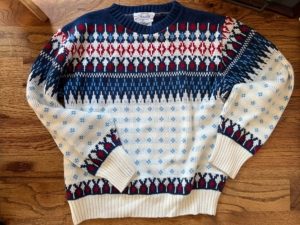
Once upon a time, I had a photo of my mother wearing it in her mid-twenties. The photo did not survive the passage of time, but the sweater did, making it at least sixty years old. I thought this sweater could be an heirloom. Unfortunately, it is not what I would consider heirloom quality – it is machine knit, made with acrylic, and poorly seamed. My idea was to create a true heirloom sweater, inspired by my mother’s 1960s sweater. It would start with raw fleece and be hand-processed, handspun, and handknitted – something my thirty-two-year-old daughter would be proud to wear now and also when she is in her eighties, as my mother is now.
Selecting the perfect fleece
I started with Targhee, a breed I have historically loved. The fleece I purchased turned out to be VERY fine and quite short. The fiber was so fine, in fact, I found it difficult to comb with my large English combs. Though I still love Targhee, I needed a yarn that was rugged and durable, if it is to survive a half century or more.
Backpedal just a bit:At one time I thought I might like to raise sheep. Hubby vetoed that! As we live in the Southeast United States, it is hot and humid and generally not a great climate for sheep. After some research, I found a breed that is supposed to thrive in our environment: Gulf Coast Native Sheep.
I found a farm in North Georgia that raises Gulf Coast Native Sheep. Serendipity, right? The farm is called the The Ornery Shepherd and is owned and operated by Shelly. And when I reached out, I learned she had just finished shearing! She invited me to come look at the fleeces, meet the sheep, and purchase what I wanted. I love it when things just work out!
My mom and I packed up our snacks and went on a road trip to the farm, about two hours north of where we live in central Georgia. When we arrived, Shelly greeted us warmly and took us to her basement where she had bags and bags of fleece, each labeled with the name of the sheep who donated the fleece. Shelly helped me inspect the fleeces and choose just the right one with the characteristics I was looking for. Afterward, she took us to the back of the farmhouse, where she has several acres of land with grazing sheep. As we approached, they all came running to meet her. What a heartwarming sight to see her sheep so excited to see her! And we met Atticus – the previous owner of my fleece.
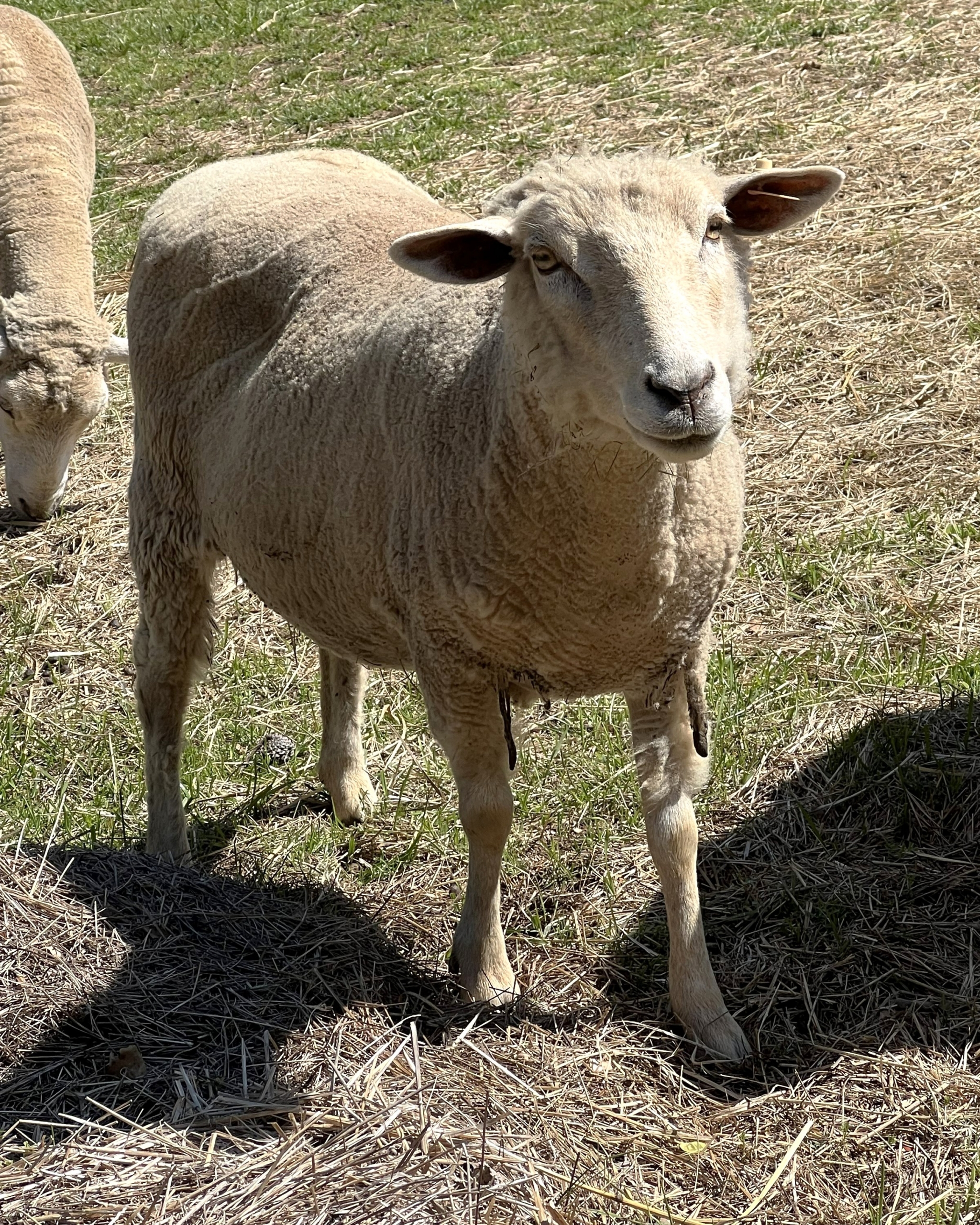
Atticus was not so cooperative for a photo, but this is one of his very cute sisters. They look just alike!
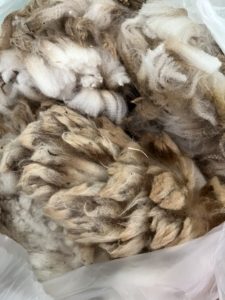
Atticus’s fleece was squishy and bouncy with a fiber length of about 4 inches, a nice crimp that was not too fine, and a lovely amount of lanolin without being gummy; and there was not a lot of vegetable matter. Perfect! I bought 3-1/2 pounds of skirted fleece with the intention of combing the fiber, anticipating having about half “wasted” – to be used for other purposes.
I was not looking for a truly worsted yarn, as I wanted the sweater to be soft, squishy, and cozy – all the things the acrylic prototype is not. I decided to spin the yarn using a backward draft (my favorite) and allowing twist into the drafting zone, a decidedly not-worsted spin.
Spinning
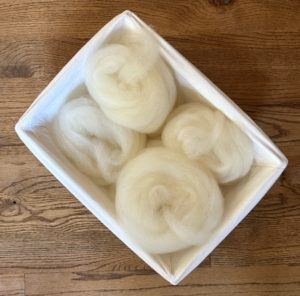
I washed the fleece with a wool scour in hot water with minimal agitation, squeezed the fleece in a towel, and then let the fiber air dry for a few days. I aligned the locks and then used large English combs to comb the fiber into beards. I then used a diz to form nests for spinning.
Funny aside: We have five dogs, and one is a spitfire chihuahua mix. I came downstairs one day with a large wad of dirty fleece in my arms. This little girl went nuts – barking, hair raised, ready to kill whatever creature I was carrying down into her territory. The wad of fleece was bigger than she is!
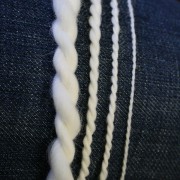
I experimented with a 3-ply, tight singles and a loose 2-ply, and loose singles with a tight 2-ply. The loose 2-ply did not have enough stitch definition and was dense, while the 3-ply felt a bit stiff and unwieldy. I settled on spinning the singles loosely, rewinding the singles, and making a 2-ply with a tighter twist. The objective was to keep the yarn soft (loose-spun singles) but to have nice stitch definition (a tighter twist in the ply).
I spun the singles at about 3 TPI and then plied at a twist angle of 30 degrees. I ended up with 18.6 ounces of yarn with a “waste” margin of 55 percent. I got about 1,060 yards per pound (YPP) and the final yarn knit to a gauge of DK weight yarn. I finished all the yarn samples and the final yarn in hot water with a gentle wool wash. I snapped each skein several times and then transferred them from cold water to hot water three times. I pressed the skeins in a towel and then hung them without weights to dry naturally.
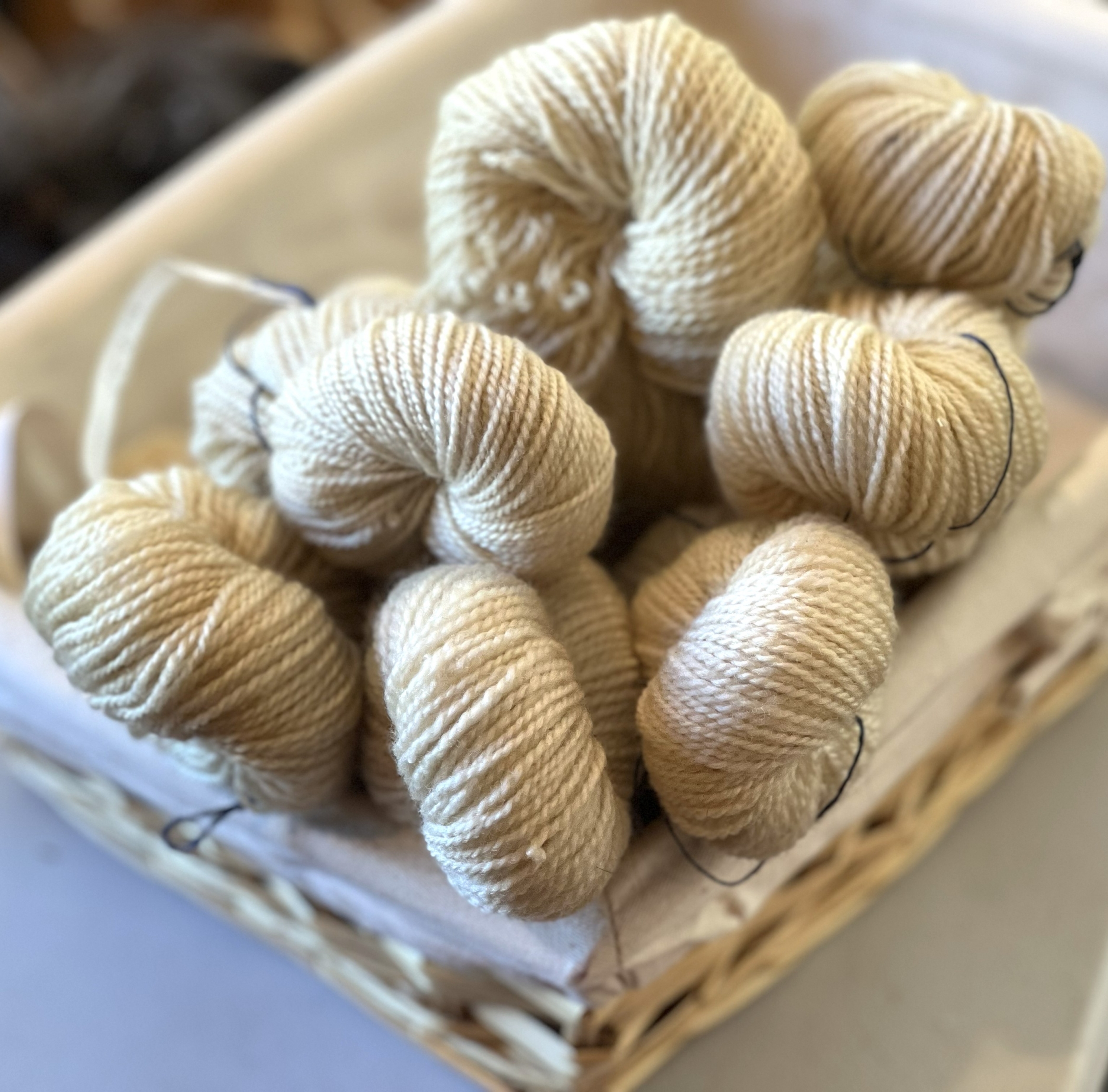
The Gulf Coast Native fleece is soft but not limp and knits into a rugged and springy fabric. I am in love with my yarn!
Dyeing the yarn
Now the terrifying part of the process – dyeing. One cannot knit a color-stranded yolk sweater in one natural (though beautiful) color! Well, I would wonder what the point was. So, time to dye.
I had a revelation when I realized that just because the inspiration sweater was white did not mean my sweater also had to be white. As it turns out, I was in a brown mood, and I’ve always loved brown and blue together. After playing around with several yoke patterns, I chose one that used four colors.
Let’s be clear, I am not a dyer – my method involves putting things in the dye pot and hoping for the best. Absolutely nothing I dye is even remotely reproducible. There would be no dyeing more if I ran out, so I had to decide how much yarn would be needed for each color in advance. Terrifying. I guesstimated my yarn requirements, tested my colors on paper towels, and got to it.
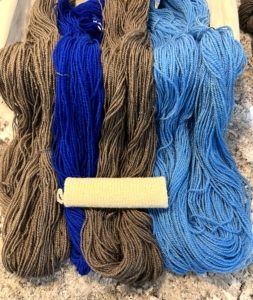
I had hoped for a bit more value difference between the light blue and the brown – the brown came out a little lighter than planned and the light blue came out a bit darker – but I liked what I ended up with, so I decided to leave them. The dark blue was another story. It came out of the pot very bright. To mellow it out, I left it in water for another night and put it into a second dye pot to dull it just a bit.
Once the colors were done, it was time to write the pattern and begin knitting – and hope my calculations for yarn requirements were on point, my gauge was true, and my yoke would fit.
Knitting
On October 30, 2025, I officially cast on, and I finished the sweater on December 27, 2025. I knit the sweater from the top down in the round. The yoke ends with some raglan increases to help with the fit. The sleeves are then continued from the yoke to the cuffs. The stranded knitting is not in the Fair Isle tradition, as the floats in some places are long, three colors were used on several rounds, and even four colors were used for the lower hem pattern. (What was I thinking?)
In the end, my calculations worked! I have 0.2 ounces of white, 1.9 ounces of light blue, 0.2 ounces of dark blue, and 1.1 ounces of brown left. Whew! I overcalculated the light blue quite a bit, but better safe than sorry. Also, I would have liked the sweater to fit a bit looser but certainly would have run out of yarn had I attempted it. All is good in the end!

The finished sweater weighs 1 pound and 4 ounces. It is squishy, very warm, and just as I hoped!
My objective when I began this project was to create a pattern from “sheep to sweater,” something that was beautiful and high quality that could be handed down for generations to come. From the beginning of the spinning process to completing the sweater took about eight months. Not too bad, as long as I am not in the 1800s and don’t have to feed, clothe, and care for a family! My family would freeze to death!
The sweater fits my mother, me, and my daughter. Three generations can wear it already. Purpose fulfilled!


Leave a Reply
Want to join the discussion?Feel free to contribute!