
Experimenting with a Range of pH Solutions in Finishing Handspun Linen Yarn
words and photo by Sherri Norland
More than a decade ago I began my spinning journey with a kit that contained wool top and a drop spindle. My craft room was already bursting with cloth and yarn, and the last thing I needed was another hobby. I am a sweater knitter and wanted to learn more about how fiber becomes yarn. My creative space began to fill with fiber braids, books on fiber, fleece, and all manner of plant and animal fiber. Additional drop spindles were obtained, followed by the acquisition of spinning wheels. As more handspun yarns accumulated, a rigid heddle loom was added to the crafting space.
Methods of finishing linen yarn
Spinning has become both a passion and a source of curiosity for me. Usually I spin animal fibers, but plant fibers are a new challenge. Lately I have a fascination with spinning flax. While reading about the history of flax fiber to linen yarn and textiles, I came across numerous techniques employed in the finishing of linen yarn. Most methods involved boiling water and the use of an additive of some kind for cleaning the yarn. The type of additive used to finish linen yarn varied, and my interest began to focus on these solutions.
What is “finishing” regarding linen yarn?According to Linda Heinrich (1), linen yarn finishing is a two-step process which involves setting the twist by presoaking the yarn and scouring with varying chemical treatments to cleanse it. Other finishing techniques for linen yarn can involve bleaching (2) and physically beating the fibers, a practice known as beetling (3). Some techniques combine beetling with temperature shifts: freezing and beating the yarn, then boiling and re-beetling it (4). Finishing linen yarn may include presoaking, scouring, bleaching, beetling, and exposing it to dramatic temperature changes. I’m mainly interested in chemical finishing and scouring solutions.
Spinners typically scour linen yarn with alkali bases instead of acids (5) (6). Strong acidic solutions combined with boiling are generally discouraged, as they may damage bast fibers like flax. According to the authors of the Big Book of Flax (7), linen yarn was traditionally soaked in wood-ash solution baths for several hours or even days. The discussion also suggested using various solutions such as different types of farm animal manure, sour milk, lye baths, or diluted sulfuric acid.
Setting up my experiment
This sparked my curiosity, so I decided to experiment with how linen yarn reacts to different pH levels during the process of scouring.
To begin, I wet spun natural flax commercial roving into 2-ply linen yarn using an antique (circa 1890s) Norwegian flax wheel. I spun singles Z and plied them S. The equipment I used included a digital scale that measures grams, a metal-based measuring tape, a wooden ruler, a McMorran balance, and pH litmus strips. The wraps per inch (WPI) for all pretreatment samples came within a few wraps of each other, ranging from 24–28 WPI, giving a Craft Yarn Council (8) yarn weight of 1 or Super Fine (14–30 WPI). The grist for all pretreatment samples ranged from 1525–2000 yards per pound (YPP). For weaving, that might correspond to a 10/2 wet-spun linen yarn.
The freshly spun sample skeins of 2-ply linen handspun yarn were ready for the first stage of the finishing process. I weighed the dry yarn samples on a digital scale. To set the twist, every skein except the control (which received no treatment) was soaked in room-temperature tap water for 1 hour. Step two of finishing the yarn involved scouring. For scouring I used 5 drops of dishwashing liquid in 1 gallon of tap water, along with whatever chemical additive was needed to achieve the pH for the solution. My experiment used citric acid, baking soda (sodium bicarbonate), washing soda (sodium carbonate), ammonia, and lye. For each treatment chemical, I added 2 tablespoons (T) per gallon of water. I tested the pH of each solution prior to boiling using pH test strips (litmus paper). I boiled each solution separately with its sample skein for 1 hour (99 degrees C at 960 ft elevation). I rinsed the yarn samples with room-temperature tap water after 30 minutes of cooling and allowed them to dry thoroughly.
Results
The variables I was interested in measuring were weight, length, WPI, grist, strength, and color. The results show that the most weight was lost with the lye treatment. Coming in second for weight loss was the washing soda treatment and third was the citric acid treatment. The ammonia treatment had the least weight loss of all the treatments, which is interesting since just the soaked treatment showed more weight loss.
| Pretreatment (PT) | After treatment (AT) | Percent difference | |
| No treatment | 34.5 | 34.5 | 0% |
| Soaked pH = 7 neutral | 34.5 | 33.5 | -2.9% |
| Citric acid (2 T) pH = 3 | 19 | 18 | -5.3% |
| Baking soda (2 T) pH = 9 | 18.5 | 18 | -2.7% |
| Washing soda (2 T) pH = 11 | 27.5 | 24 | -12.7% |
| Ammonia (2 T) pH = 8 | 30 | 29.5 | -1.7% |
| Lye (2 T) pH = 14 | 30 | 25.5 | -15.0% |
| Weight measured in grams | Percent difference = AT/PT * 100 -100 |
Data for length and WPI showed little to no change. It was harder to discern slight differences in the length and WPI pre- and post-treatment using my handspun yarn, and the yarn did have some stretch, which I did not expect from a linen yarn. The stretch might be because I used commercially prepared roving rather than long line flax. The roving’s shorter fiber staples might result in yarn that has some ability to stretch.
The grist showed an increase in yards per pound after most of the treatments, which I expected, but the washing soda sample showed a decrease in yards per pound. The only explanation that I have is the inconsistent nature of my handspun yarn. The McMorran balance assumes that the yarn is consistent throughout, and mine was not, however hard I tried. Repeated scours for each sample might show different results. It would be interesting to repeat this experiment using commercially spun linen yarn and compare the results.
I was also interested in variables such as strength and color. To evaluate strength, I used the standard weaver’s test for yarns used in warp, which is to take a strand of yarn (roughly 6–8 inches) between your hands and give a sharp tug. None of the samples of yarn seemed different from one another as far as breakage and all took more than one tug to break the yarn. I was surprised the citric acid solution did not weaken the bast fibers more than the other solutions, despite many sources suggesting acids do so. More testing with a lower pH of 1 or 2 might show a different result. The most obvious change to the samples pre- and post-treatment was color. In my observation of the color of the treatment samples, the citric acid sample seemed slightly more yellow than the washing soda or lye solutions. Digital photographs show the differences in color I observed in the samples (see photo). The stronger the pH of the solution, the more change occurred in both the color and weight of the samples.
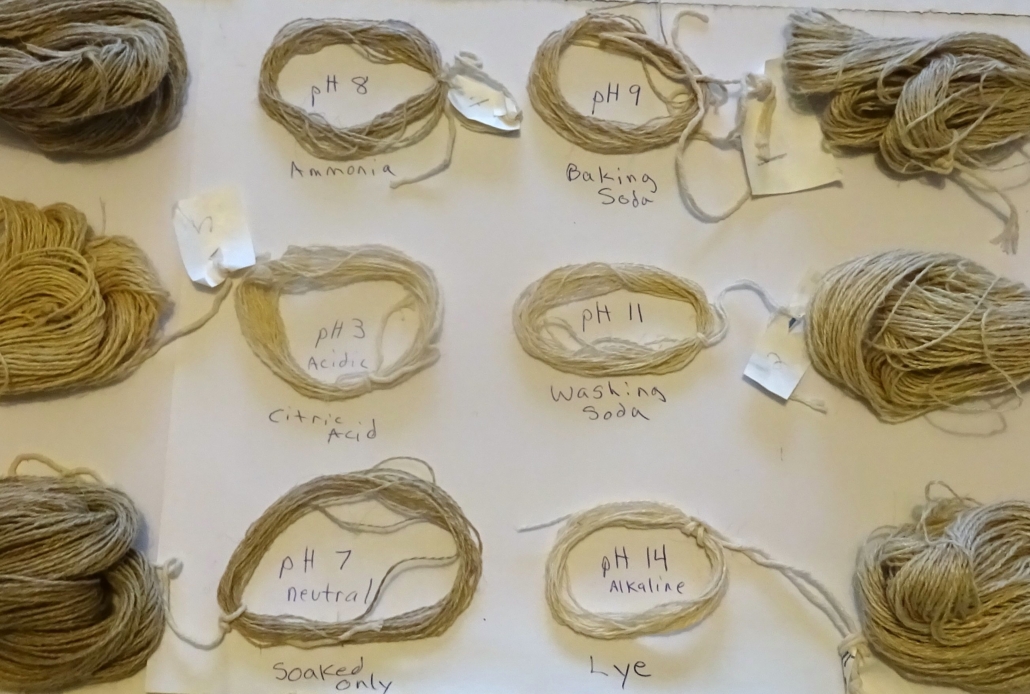
Conclusions
There were so many variables to consider when conducting this experiment. The variables of weight, length, WPI, grist, strength, and color very much affect the appearance and drape of the final product. It became clear to me that methods for finishing handspun linen yarn should vary depending on the intended use of the final product. If you want a very light and soft final fabric, then you might subject the linen yarn to relatively harsh finishing treatments. If a crisp fabric is desired, then a less harsh finishing treatment would be required. My conclusion for finishing my linen handspun yarn seems to agree with most sources that use a strong scouring solution with a pH between 11–14 plus dishwashing liquid. A single scouring treatment is sufficient, as excessive scouring prior to weaving could compromise the strength of the yarn. This consideration is particularly important for yarn intended for use as warp, which is subject to higher tension and friction than the weft. I plan to use my handspun linen yarn in weaving and to scour the linen cloth again when it comes off the loom. My goal is to weave enough linen cloth from my handspun linen yarn to sew a blouse.
Resources and reading list
- Linda Heinrich, “An Introduction to Spinning Line Flax,” in A Guide to Spinning Flax: Linen Spun from Flax Fibers, ed. Amy Clarke Moore (Spin Off ebook, 2011).
- Laura Loewen and Sylvia Smith, “Myth Busting: Bleaching Linen,” PLY Magazine, Autumn 2025 (Plants).
- Bette Hochberg, Fibre Facts (pub. by author, sixth printing, 1993).
- Stephenie Gaustad, The Practical Spinner’s Guide: Cotton, Flax, Hemp (Interweave, 2014).
- Joybilee Farm, “Finishing Handspun Linen Yarn,” blog post.
- PLY Magazine, Spring 2018 (Flax).
- Christian and Johannes Zinzendorf, The Big Book of Flax: A Compendium of Flax Facts, Art, Lore, Projects and Song (Schiffer Publishing, 2011).
- Yarn weights, Craft Yarn Council.
Sherri Norland uses her science background to learn more about her hobbies of spinning, sewing, knitting, and weaving. Curiosity, love of reading, and a drive to learn fuel her crafting passion. She believes that handmade should equal well-made. Sherri is retired and lives with her husband.


Leave a Reply
Want to join the discussion?Feel free to contribute!