
Dying, Dyeing, and Me
words and photos by Miles Hilton
The first time I visited Shatzi Weisberger’s apartment, she herded me over to an ornately carved wooden box by the window. Gently, she lifted the lid to expose folds of white fabric, fringed with embroidery. A sticky note on top read “Shroud.”
“This is my death shroud,” Shatzi explained in her thick New York accent. And she rattled off, as seamlessly as she might order coffee from a favorite restaurant, the plans she had made for her own death and burial. She was eighty-seven at the time, and had been preparing for her death for decades.
And boy, was she prepared. Every item in Shatzi’s house had a sticky note with someone’s name on it – the person who would inherit that item when she died. Her Do-Not-Resuscitate paperwork was pinned prominently by her headboard, and she kept a running email list of people to be notified when she passed.
Don’t be fooled into thinking Shatzi was depressive or morose – quite the contrary. We met at Dyke March in NYC in 2017, which she attended in her wheelchair. She was a fixture of protest marches in the city until well into her nineties, smoked more weed than any twenty-something I knew, and had a sharp sense of humor. Her knowingness of her death enlivened her, gave texture to her life.
While it may seem theoretical, all this talk about death and dying comes down to a basic, physical question – what to do with the body. Religious traditions often suggest an answer (Shatzi’s plans for her death were informed by her Judaism), but in today’s increasingly impersonal and capitalist world, many people are pressured toward two options: cremation, or embalming and burial.
Shatzi encouraged me to think carefully about whether these were what I wanted for my body, and I decided that, like her, I wanted to be buried somewhere in the Great Northeastern Forest. Forest burials usually involve wrapping the body in a shroud, and most forest cemeteries will provide one. But I’m a handspinner.
So I decided to weave my own shroud.
That’s not quite doing it justice – I decided to spin, weave, and dye my own shroud. As a practice in meditating on my own death. As a thank-you to my dearly loved body. As the most important work of art I will ever create, and the most important garment I will ever wear.
Spinning and weaving something meant to decompose comes with its own set of considerations and constraints. Natural fibers only – obviously. I have an affinity for wool, so I sourced lightly processed roving from farmers around Western New York, where I was living at the time. I chose white wool, to make the dyeing process easier. Using a short forward draw, I spun thin worsted singles, fairly tight, on my Ashford Kiwi – my usual singles preparation for weaving. Two-plying these singles gives a balanced yarn that’s strong enough to warp with.
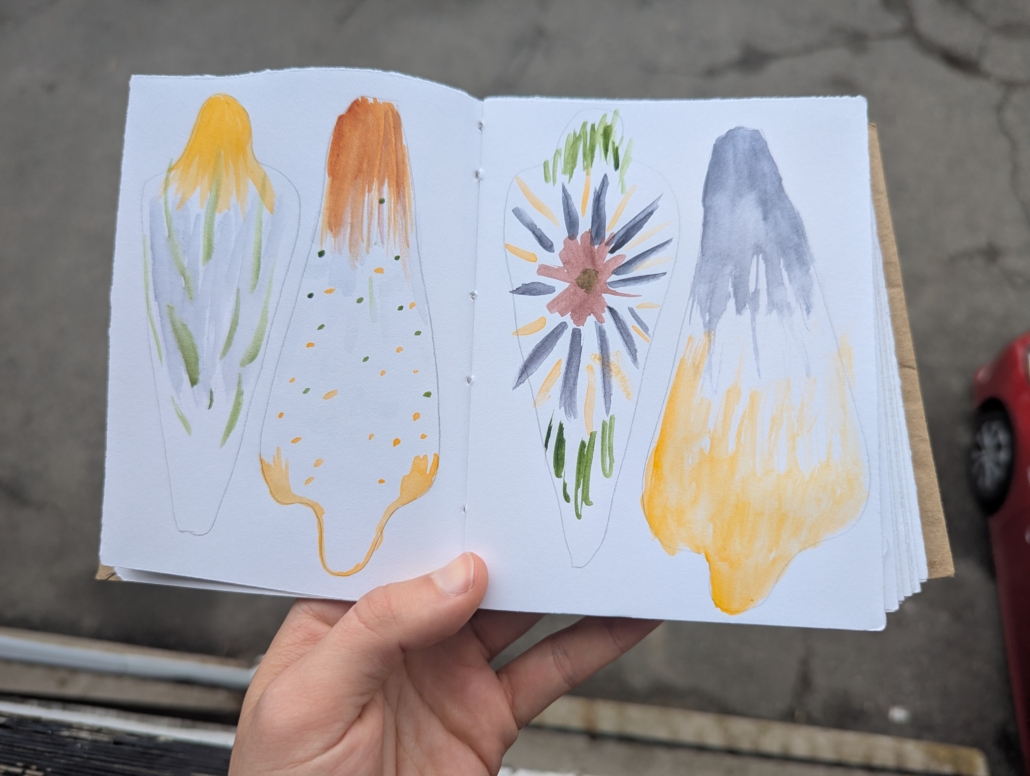
While shrouds are typically white, and mine will be mostly white as well, I want a bit of color in the mix. Gold cascading down the head of the shroud, meeting streaks of pale sky-blue along the body. Greens and browns to decorate the feet, with pops of magenta along the crown and ties. Again, synthetic dyes were off the table, as were heavy metals in the mordanting and dyeing process, so I turned to dye plants. I chose to plant woad, weld, and madder – both because they grow well in Western New York and because they’re important to me ancestrally – and responsibly foraged goldenrod, black walnut, and pokeberry, all of which are indigenous to the area I live in.
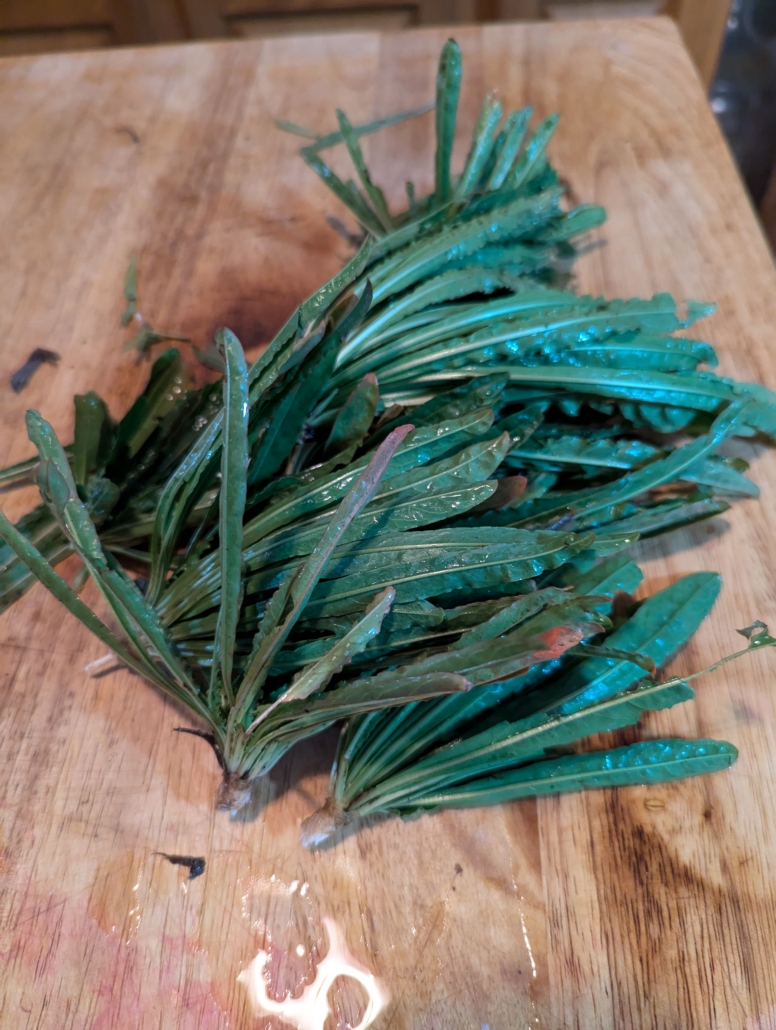
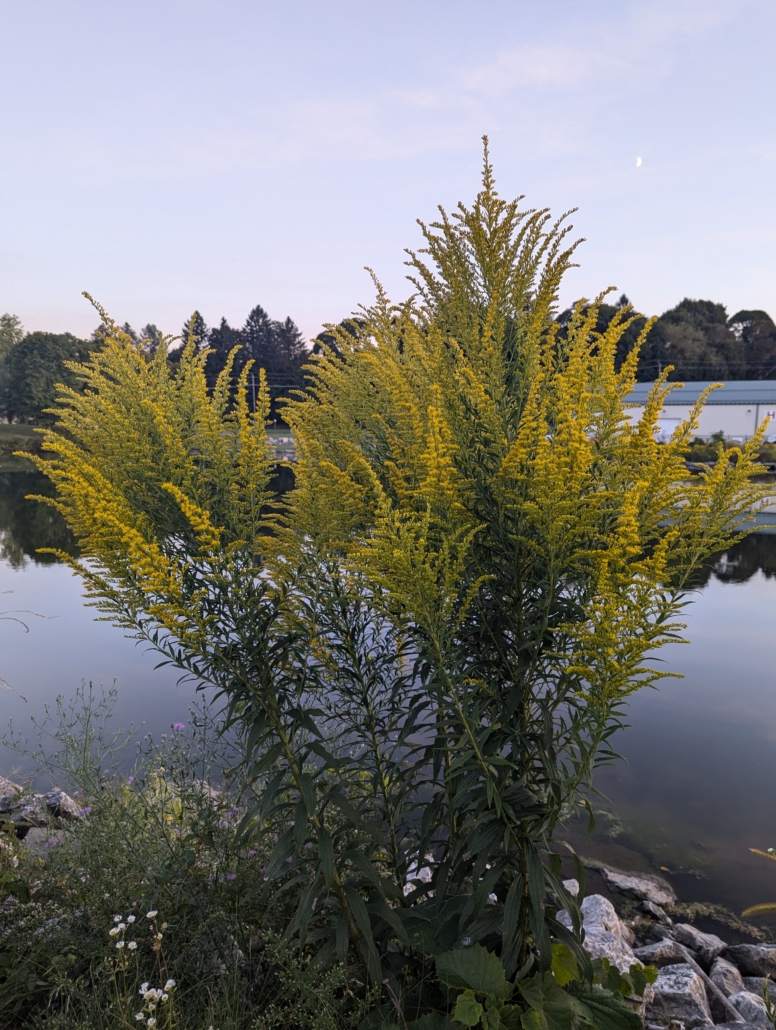
A note on foraging – I took care to forage only plants that were abundant in my area. I cultivated the goldenrod and pokeberry in my own yard, and black walnut is famously generous in showering her nuts on yards, forests, and roadways throughout the Great Lakes region. I foraged according to principles synthesized by Dr. Robin Wall Kimmerer in “The Honorable Harvest,” an essay in her collection Braiding Sweetgrass, and only after several years of attending to the land in all its seasons.
With Carol Leigh Brack-Kaiser’s Nature Provides Dyes for Rainbows as my bible, I set out on a months-long experiment in growing and using these dye plants. Spinning is something you can sit down and do whenever you feel like it, but plant-based dyeing sets its own schedule. You harvest when the plant is ready, and dye soon after. If you don’t go foraging when the berries, leaves, or nuts you need are at their fullest, you won’t get the color you want. My entire late summer and early fall in 2024 went at the pace of the flowers and berries ripening around me. Plans schmans; one weekend was all about goldenrod, the next was all about poke. Getting blues from woad requires a complex, multi-step process that made me feel like a chemist in a lab and took all of a long weekend to fully attend to.
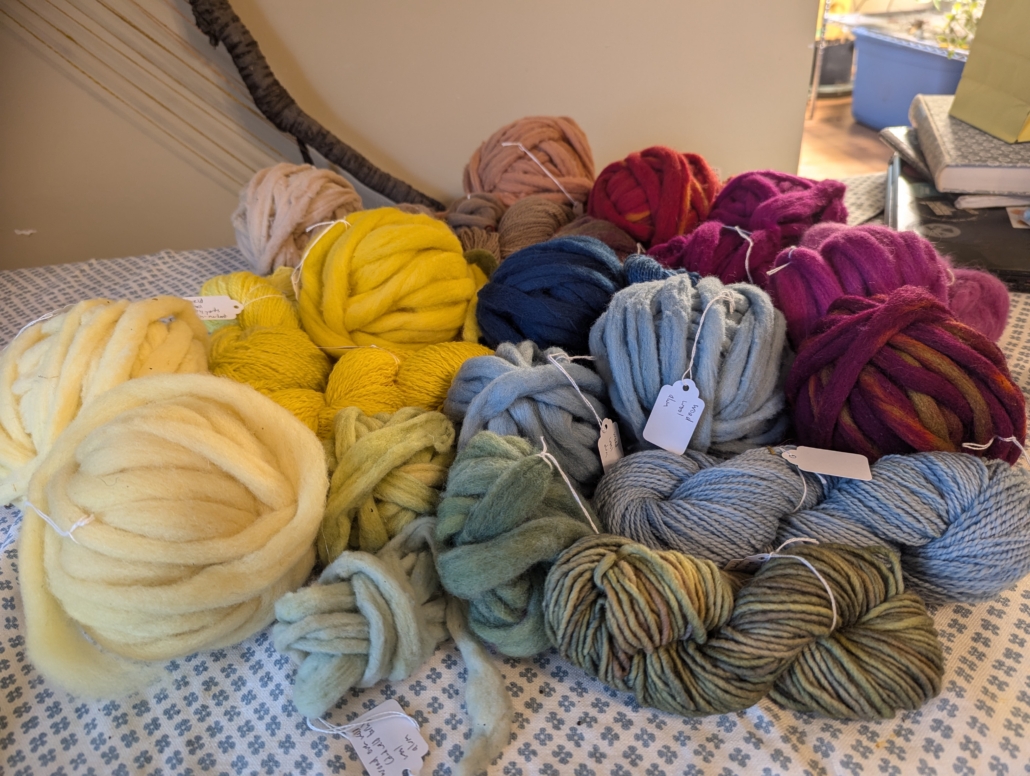
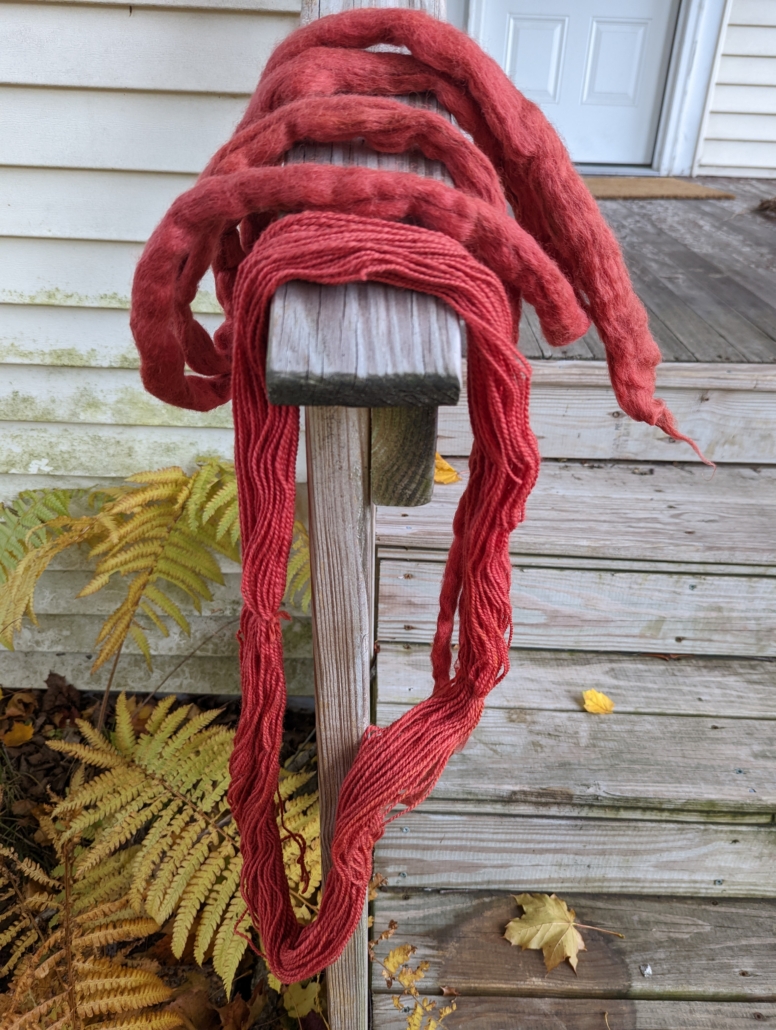
As my dyepots bubbled and skeins of finished yarn simmered in their alum baths, I met these plants, some of whom I had lived around for years, in a whole new way and on their own terms. This is a good practice, I think, for life, but also for death. After all, death comes to us on its own terms.
Spinning is deeply tactile, as every handspinner knows. Every inch of fiber goes between your fingers – more than once, if you card or comb your fiber, or ply your finished singles. Dyeing is also tactile. I soaked clumps of leaves, then smooshed their juices out between my fingers. I pressed the juice of berries through sieves and broke nut-pods apart. I dipped skeins into dyebaths over and over again. That whole season, splashes of overlapping color stained my hands.
I’m weaving the shroud on my Kromski Harp rigid heddle loom, letting myself play with pick-up stick patterns drawn from Textures and Patterns for the Rigid Heddle Loom by Betty Linn Davenport. When it comes time to weave the ties – strong woven bands that fasten the shroud round the body – I’ll use tablet weaving. This skill will be new to me, just as plant-based dyeing was a new skill, and just as this is the first time I’m spinning at this volume. Even as this project is helping me relate to my own death, it’s also driving me to expand into my present aliveness, making more time for a craft I love, and learning new ones along the way.
By the time I’ve finished this shroud, how many times will my fingers have handled each square inch? A dozen? More?
This process, as you can tell by now, has been going on for years. But I’m in no rush. I have decades, hopefully, before the shroud will be needed. Decades in which the process of making it will have connected me more deeply to the animals that gift me wool, the plants that gift me color, the human communities that gift me the knowledge and tools of spinning and weaving, and the land that underlies it all. When my body is wrapped in this garment and returned to Earth, all of these relationships of support will go with it.
Years after I first visited her apartment, around the same time that I was learning how to spin, Shatzi died at home, exactly as she had planned. She was buried, exactly as she had planned, in a forest cemetery. Wrapped in that shroud.
I like to think of the shroud she so carefully folded being gently wrapped around her by the loving hands of her community. I like to think of her body, which she used to the fullest for decades, gently melting back into the Earth surrounding it. I like to think of the gratitude of the worms, of the trees and of the mycelium, for so great a gift. And I lovingly and deliberately prepare my own gift – my shroud – for when the time comes to return this body to the Earth.
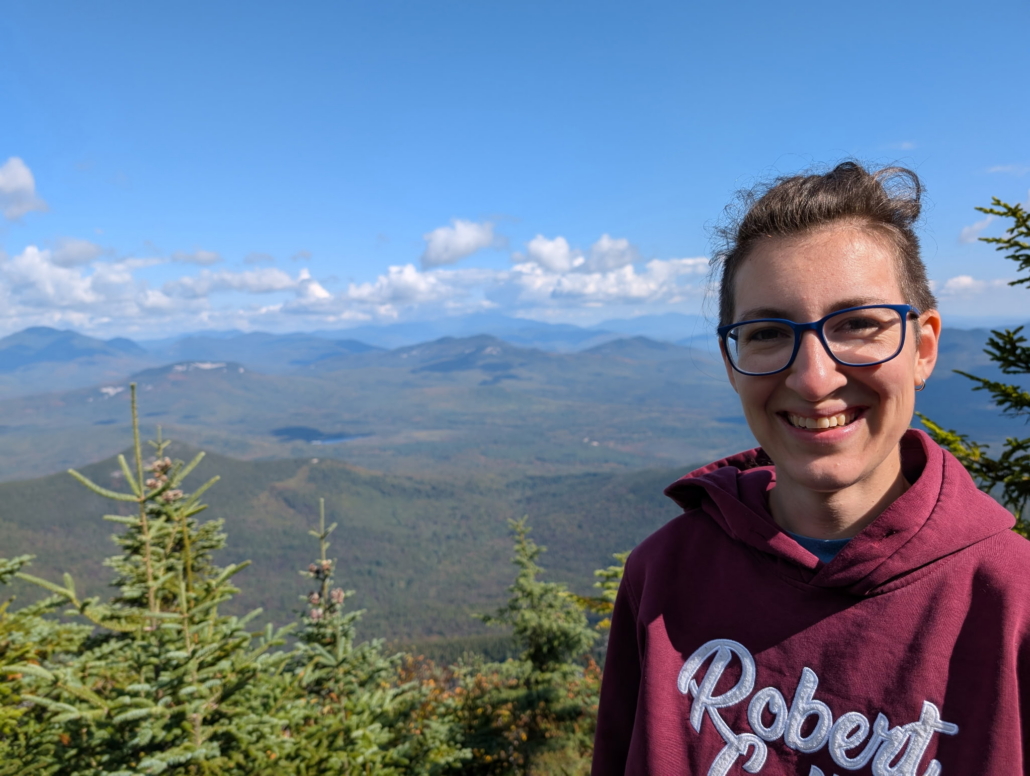
Miles Hilton (they/them) is a human being from planet Earth who prefers to live in deciduous forests. They are a writer, handspinner, and graduate student at Harvard Divinity School, where they study comparative religion. They live in the Boston area with too many looms for a two-bedroom apartment.


Leave a Reply
Want to join the discussion?Feel free to contribute!