
Mixing Things up for a Sweater
words and photos by: Johanna Carter
I always admire those who are able to spin mountains of yarn for a big project, ready to knit a wonderful sweater or cardigan. It is a satisfying feeling when you finish all that work, especially if you started with washing and combing the wool or even raising your own sheep.
Mixing spinning and knitting
The typical way to work through a larger project is to spin all the singles first and ply them in a particular order so you get the yarn even throughout the whole project. I don’t have so many bobbins, but my bigger problem is that I am quite impatient and want to get on with knitting once I have an idea. And normally, my brain is full of ideas for fibre work and the limit is the time, as I am a musician and teacher. I can’t sit at the spinning wheel for a long time if I’m not on holiday, so during the school year I mostly knit, and during the holidays I can dye, spin, use my drum carder, and do lots of fibre work. The only time I was able to produce bigger quantities of yarn before I knitted them up was during the Tour de Fleece in the two years during the pandemic, when we did not go on holiday at the beginning of July.
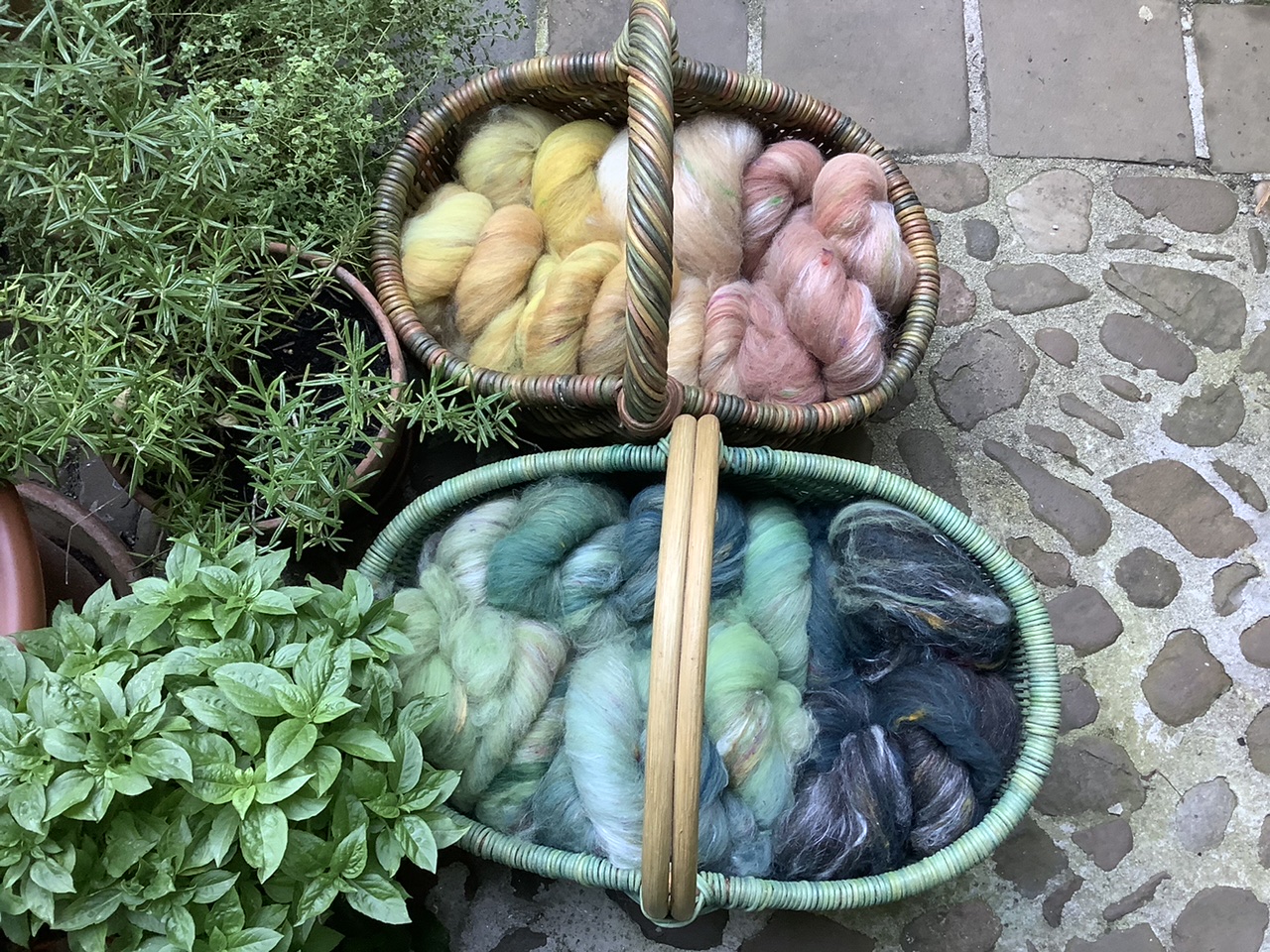
A highly photogenic collection of naturally dyed fibres.
I like to finish knitting one big project like a sweater or cardigan before I start the next one, or at least until I can’t carry it in my bag easily anymore, so I have an excuse to begin the next one. Sometimes it is good to have a second project on the go – I call it mindless knitting, where I don’t have to look very much – which I can keep my hands busy during Zoom or other meetings, which helps me listen.
Mixing colours and fibres
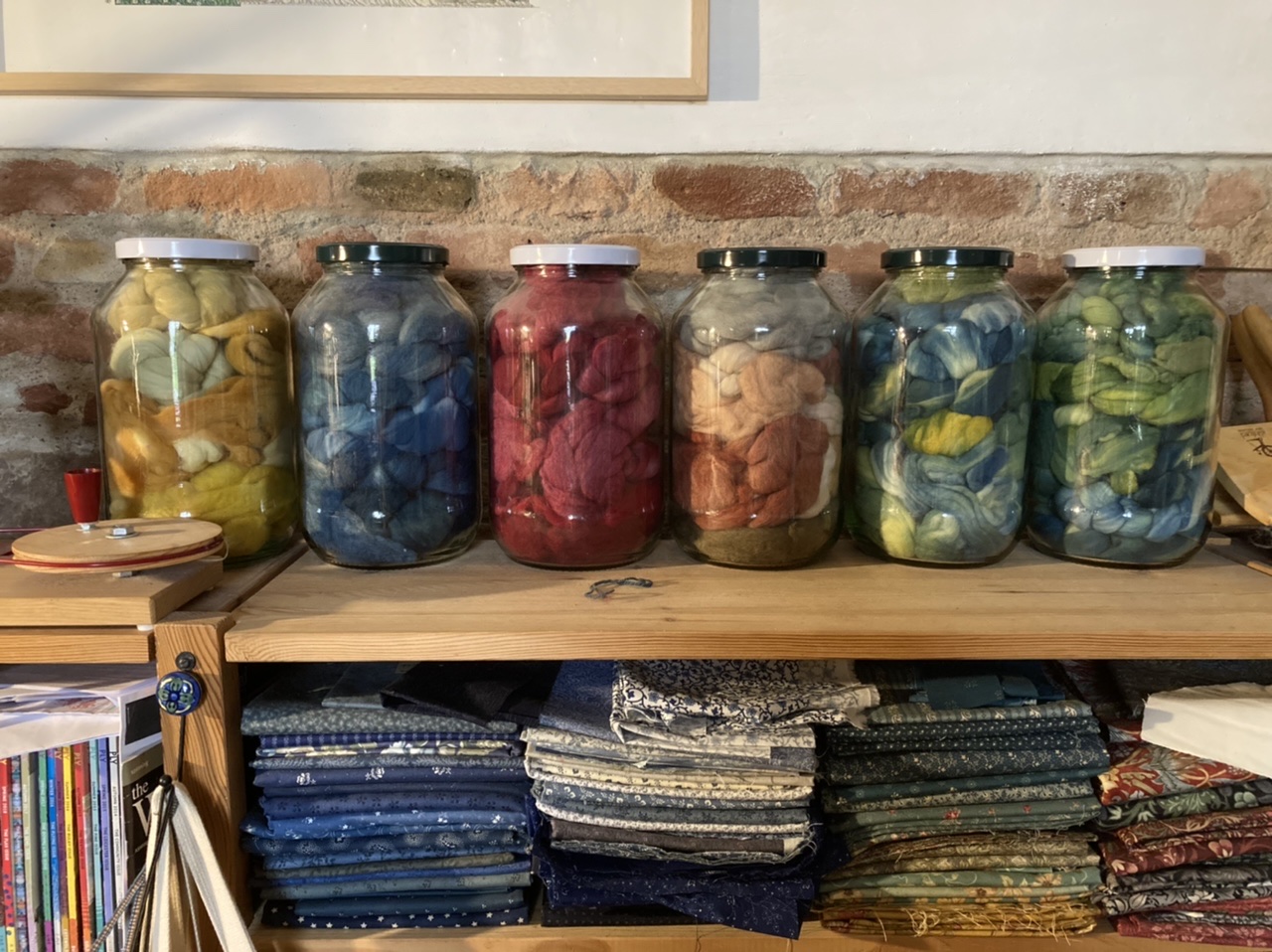
Usually I dye my yarn with plants which I collect in the woods or get from garden flowers. I also use cochineal and indigo, which I buy, to get lots of different colours. I really love the greens and blues I get from dyeing with indigo. I have lots of dyed wool, and all those colours give me inspiration for further projects.
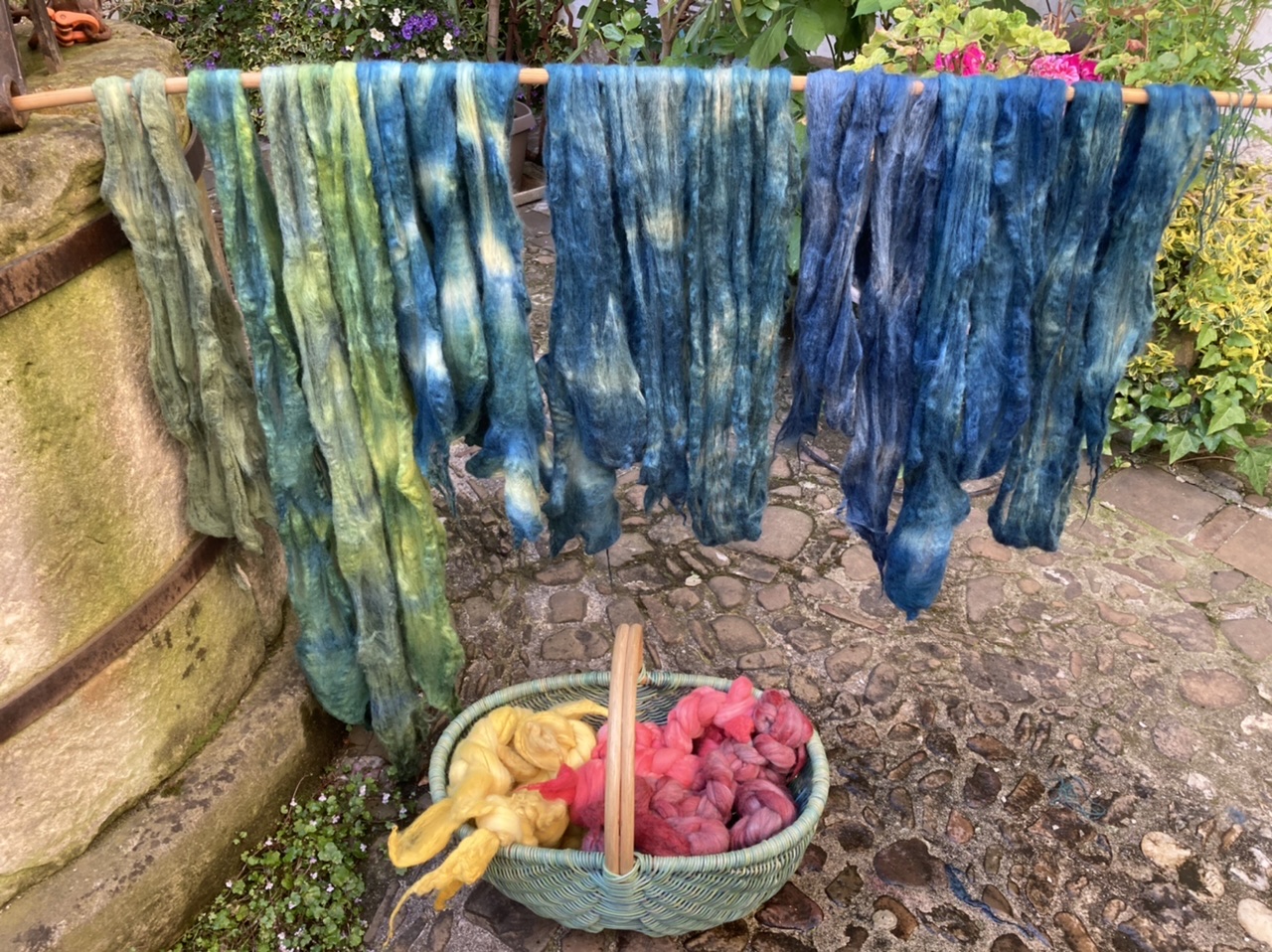
Beautiful greens and blues dyed by the author using indigo and other natural dyes.
Blending the wool on the drum carder I can get even more shades. I like to blend with fibres like silk, alpaca, or plant fibres, and I love sari silk, to get those little bits of colour in my yarn.
Fibres of different types and colours are blended on a drum carder for elegant results.
When I have an idea for the next sweater, I start carding, and then I can begin to spin. Once I have spun enough yarn – say, for one day – I cast on and start knitting, usually top down, so I don’t have to decide too much in advance about length and width.
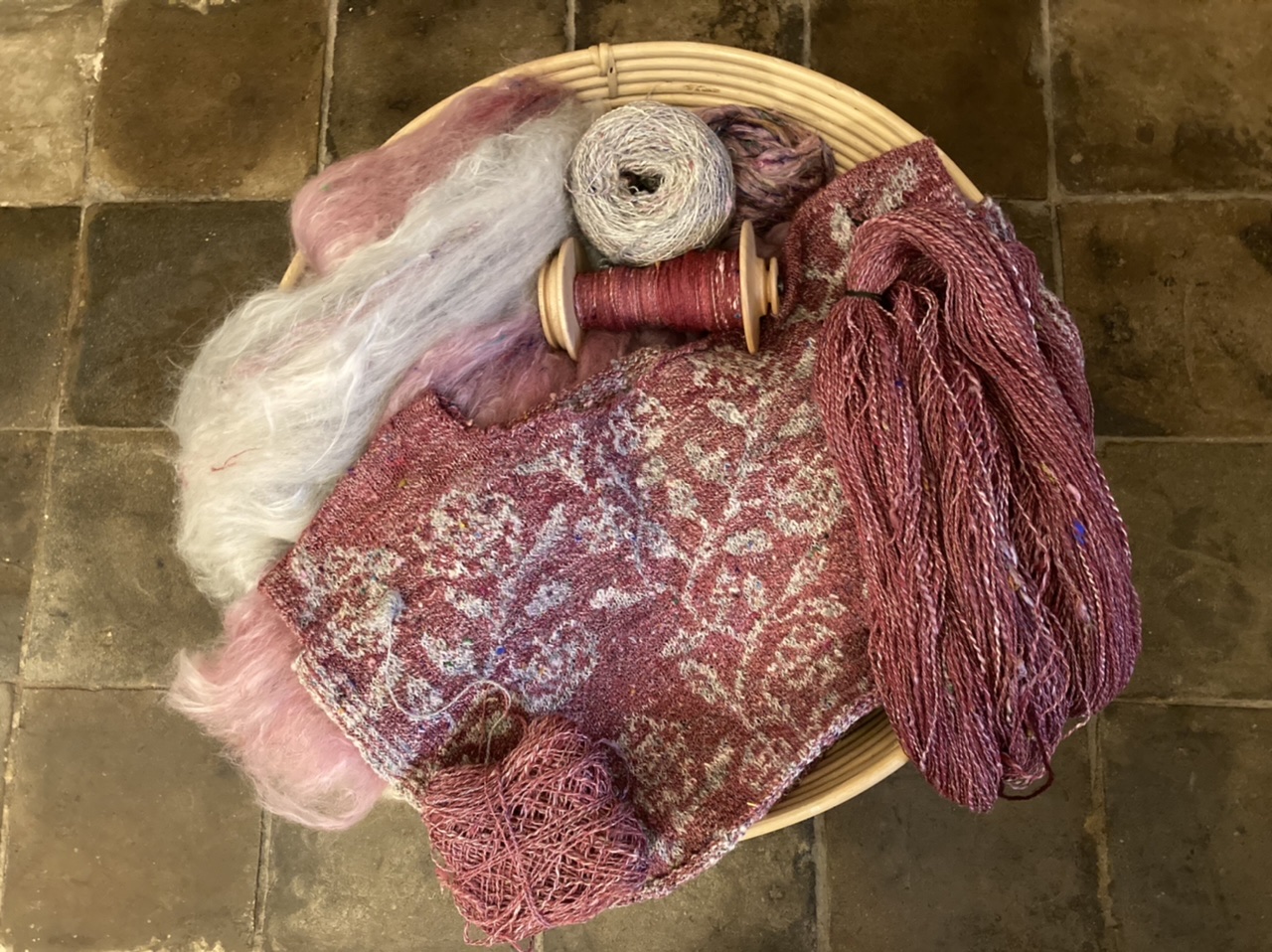
An idea for the author’s next sweater in the gathering stages.
When I spin on my wheel, I have to sit at home, but while spinning I can read a book or talk to others during online meetings. I also like to spin on my spindles, and that works on a walk, or a museum visit. I take them on holiday as they don’t need much space, and when I spin for a lace shawl, I don’t even need much wool either. At home there are spindles all over the place; I can spin when I am waiting for the kettle to boil, when the computer is slow, when I am cooking. Like that I can make good use of a short time and the yarn still grows.
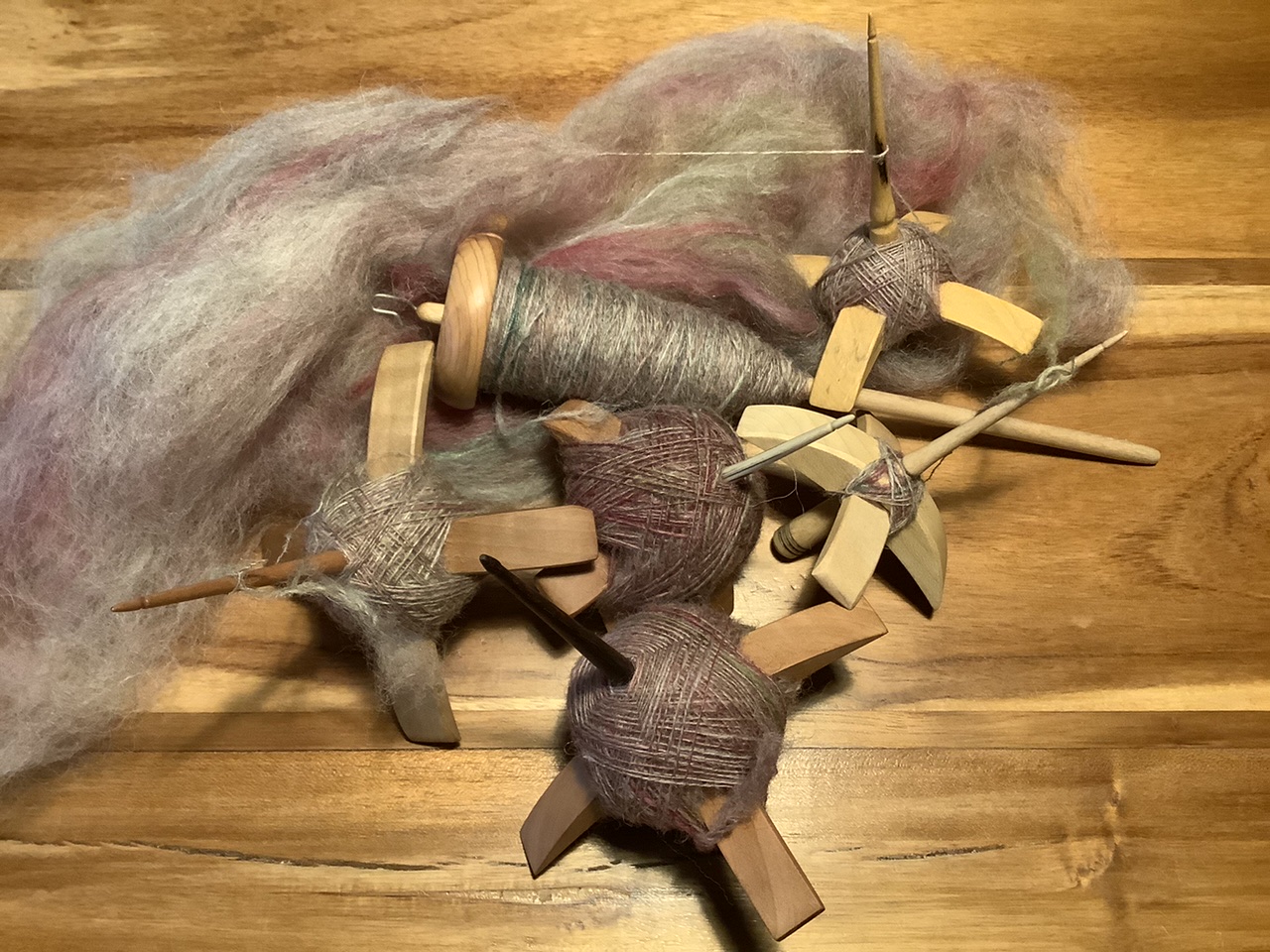
Knitting as soon as the yarn is spun helps the author complete sweater projects in a timely manner.
I can take my knitting almost everywhere, which is why I don’t want to wait to get started until I have spun all the yarn for a whole sweater. I knit at home, on the bus or train. The only thing I have to make sure of is to be one step ahead with the yarn.
I love to knit Fair Isle sweaters. My favourite method is to use only one bobbin, which I don’t even fill, because I need smaller quantities of lots of colours. Then I wind a ply ball and ply it on itself. For that I put my thumb through the ball, so I can tension the two singles with my fingers and they don’t get tangled, as long as my thumb (or a cardboard roll or a pencil) stays in the middle. I don’t have any leftovers from plying, and it is quick when I suddenly need more yarn.
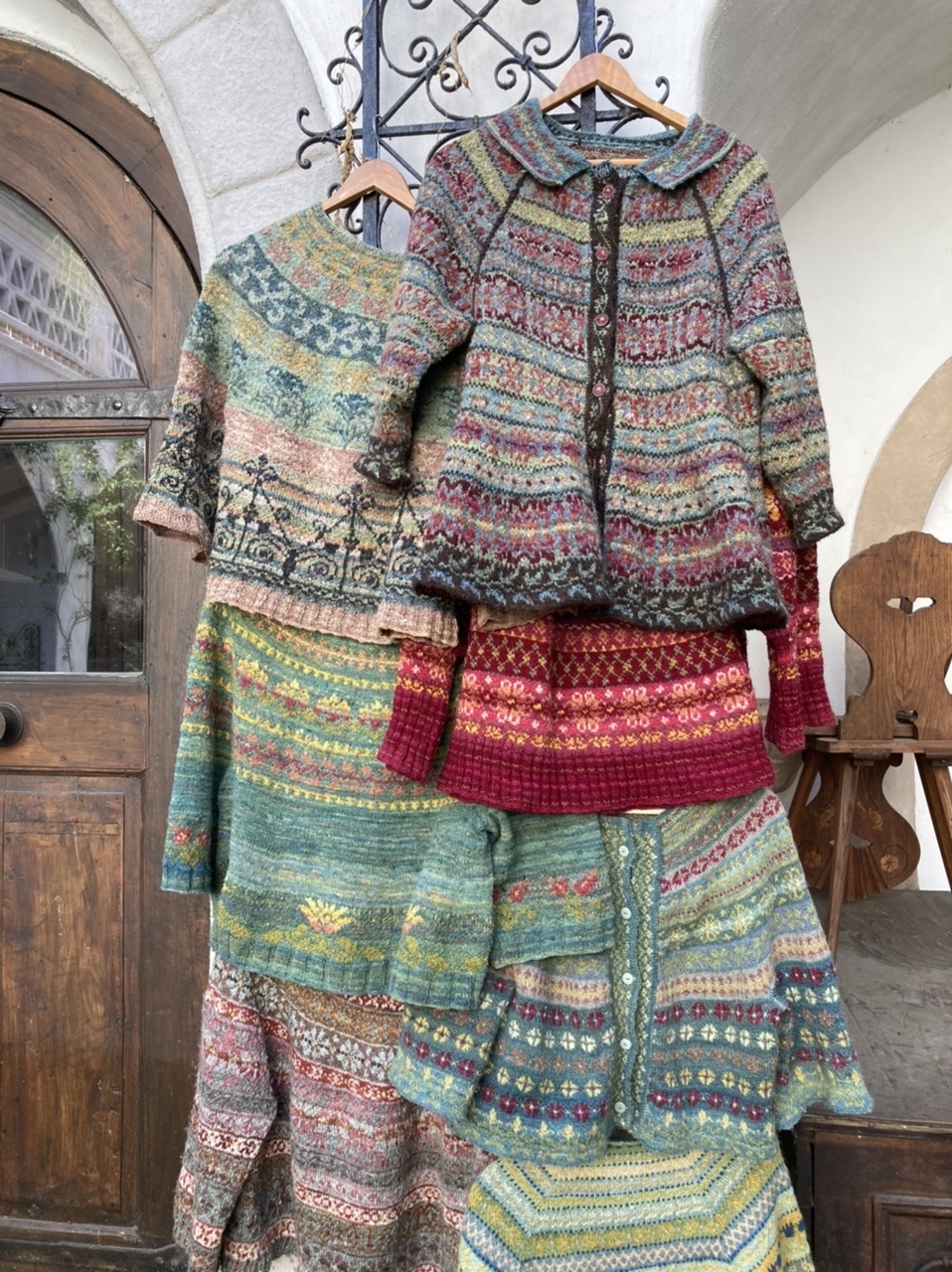
Several charming sweaters dyed, spun, and knit by the author.
I have never had problems with the yarn not being consistent enough throughout a project. I just know what yarn I want and my fingers seem to remember what to do. I am sure it is good advice to have a little card tied to the spinning wheel with a bit of the singles you are aiming for, so you can check and make sure you are spinning a consistent yarn.
Mixing breeds
There are so many different breeds, but some of my favourites are Shetland, BFL, and Jämtland – a Swedish breed. After dyeing them, I often forget what I have used, so when I do a new project it often turns out that I have used different breeds and fibres just to get the right colour. For the Fair Isle knitting I want to juggle lots of colours, which is more important to me than making a sweater out of only one breed.
Recently I made a pullover for my husband using about 12 different breeds and colours, even mixing short and long draw. For me it was a breed experiment and a way to use up lots of smaller quantities of wool I had in my stash. For that sweater I used combed top without blending.
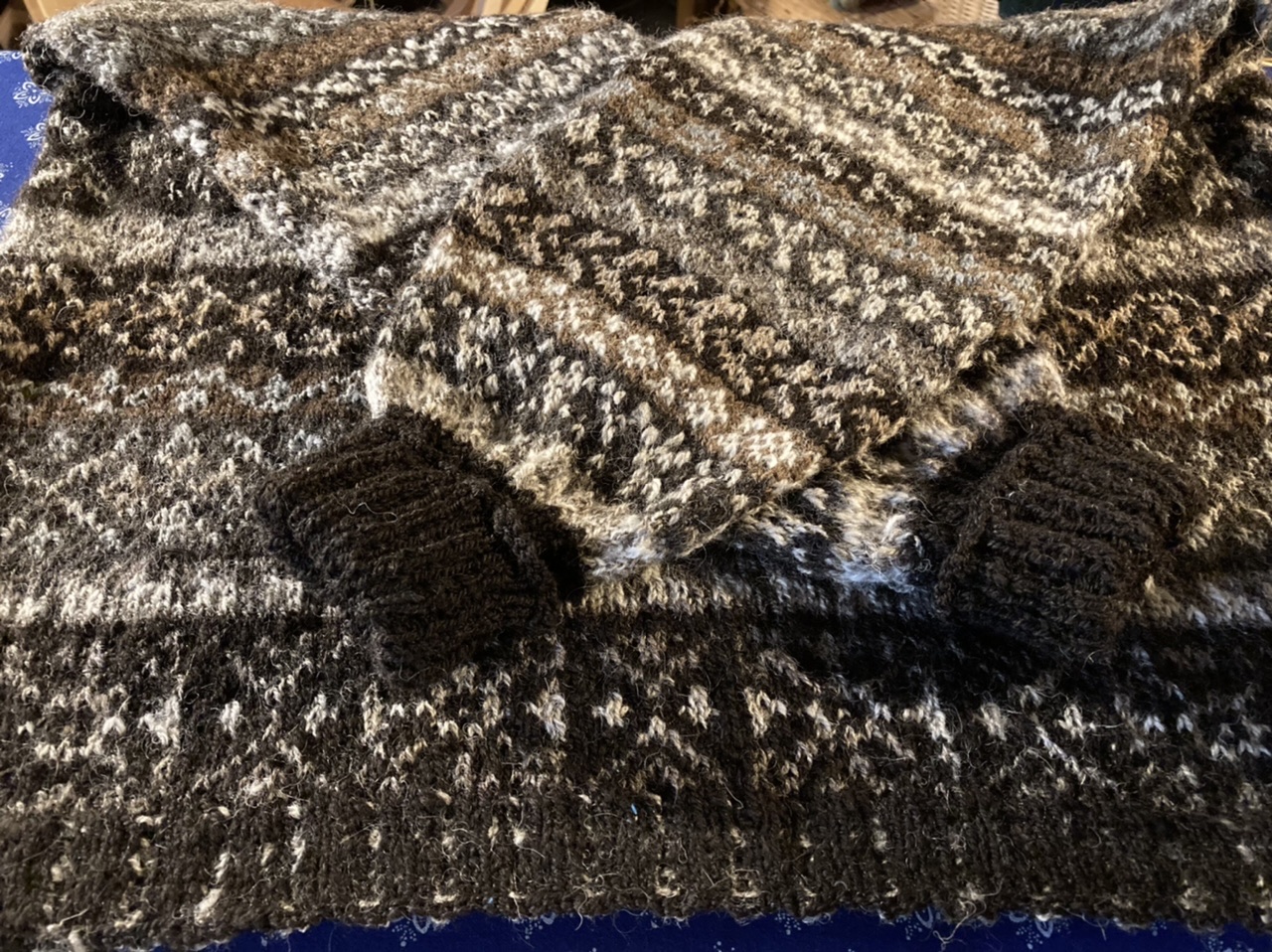
Mixing in knitting during the spinning process is a wonderful way for a spinner to avoid being overwhelmed during a sweater project.
My feeling is that some people don’t dare to start spinning for a bigger project because they get overwhelmed by the quantity they have to spin and then all the knitting there is to do, especially when you want to spin the yarn entirely on spindles. Mixing the spinning and knitting for the same project is more interesting; you get more variety and more freedom to choose what you want to do next as long as you don’t run out of yarn. It breaks the project down into smaller, less daunting parts. The only thing you might want to plan is to have enough fibre at the start, but even that is not necessary, there is always a sheep growing more wool.
Spinzilla team roster: Kate Blaney (aka puni goddess!)
 Name: Kate Blaney
Spinning nickname: “Puni Goddess”
Years spinning: 6.5 years
Location: My Fortress of Wool in Frederick MD
Spinning tool of choice for Spinzilla: Don’t make me choose! It is a tie between my Hansen miniSpinner & my Spanish Peacock supported spindles (of which…I own a lot of…)
Favorite weight of yarn: I like to change it up, but my favorite is fingering or sport weight
Favorite fiber for fast spinning: Merino Yak Silk blends carded into punis or drumcarded tribbles
Favorite treat to eat while spinning: Flavored almonds, black cherries and Jarlsberg cheese! (basically anything that you can grab a small handful of while spinning. I don’t have time to *stop* for food!)
Project you’ll be spinning for: I get bored easily spinning more than 2-4 oz of the same colorway at a time. Might break up a sweater quantity in between funky yarns. Or not. Just gonna go with what looks fun.
Personal Spinzilla goal: Minimum of 8,000 yds (hoping for over 10,000 yds!).
I was a knitter first, then I learned how to spin. So, eventually I became a spinner who sometimes knit. Now I am a spinner who rarely knits and owns Gourmet Stash, my fiber arts business. Needless to say, my house is overflowing with wool. You really can’t go into a room without seeing the byproducts of my carding everywhere, aka wool-sparkle dust bunnies. Those babies are EVERYWHERE. Doormat outside of my house, in the flower beds, on my car, in the corners of the bathrooms. Basically, don’t be surprised if you leave my home with one or two of the lil sparkly guys hitching a ride back to your house.
How to Shoot a Magazine, Prelude
When Jacey first told me that she was starting a spinning magazine, I said something like “Awesome! You’ll do great!” I even meant it. Next she said she wanted me to take the photos, to which I replied something like “Are you crazy?” The thing is, and if you know Jacey you will totally understand, when Jacey wants something, she usually gets it. The obvious next step was for me to figure out how to take pictures that would make Jacey happy. I had a million questions about how to face this project and approximately seven answers. I was painfully aware that I had no idea what I was doing.
My first approach was to do a lot of research. I was hoping to find a book in the library called How to be a Really Great Fiber Photographer in Four Easy Lessons. That book was checked out, so I ended up with some self-help books on coping with anxiety. I read way too many photography blogs, books, and magazines, and ultimately decided that beginners luck has to be a real thing. Six issues later, I am so enthusiastic about the future of my work with PLY, in large part because I can now at least identify what I don’t know. Each shoot is a little more relaxed, the editing workflow less frustrating.
In this series, I plan to explore each issue of PLY, its challenges and successes, and delve into what we learned in each shoot. I’ll share some photography techniques I have found helpful in getting more accurate photos of fiber and finished projects. I’ll also address some post processing work to correct common issues like color casts and blown out highlights. Of course I’ll share favorite photos, embarrassing photos, and behind-the-scenes shots of Jacey eating chocolate and Levi being Levi. I look forward to your questions, comments, and insight!
Spinzilla team roster: Kimberley Burnette-Dean, aka Spinnlady!
 Name: Kimberly Burnette-Dean
Spinning nickname: Spinnlady
Years spinning: almost 26 years
Location: Virginia
Spinning tool of choice for spinzilla: Kromski Minstrel for spinning, Country Craftsman for plying.
Favorite weight of yarn: DK/heavy fingering
Favorite fiber for fast spinning: mill prepared loose roving OR some of my hand-pulled roving
Favorite treat to eat while spinning: Eat? Who has time to eat during Spinzilla?
Project you’ll be spinning for: WAIT! Project? I’m supposed to have a project in mind when spinning?!
Personal Spinzilla goal: To spin AT LEAST 7,000 yards and hopefully much more!
I confess. I am a serial crafter/hobbyist. I become obsessed with a particular craft/hobby, quilting for instance. Buy everything I need for it, well, maybe some things that I don’t need too, and obsessively work on it for several years, then I move onto the next craft or hobby. So far: quilting, spinning, weaving, natural dyeing, rug hooking, embroidery, cross stitch, knitting, crocheting, tatting, dulcimer playing, gardening, herbs, sewing, 19th century Reenacting . . . And the list goes on! This may explain why my office/craft room and my basement look like a huge yard sale in progress. I do cycle through my various hobbies/crafts, so I don’t just do them one time!


Leave a Reply
Want to join the discussion?Feel free to contribute!