
Combo Spinning as a Reflective Practice: Intentional Gradients
words and photos by Gaelle Troude
Reflective practice involves thinking about your actions, learning from your choices, and using this analytic process to improve your current skills and your future experience as well as the overall process itself. As a mental health professional, this manner of engaging with one’s activity has become second nature. Spinning became a significant part of my life about twelve years ago and plays a large role in my work-life balance. Perhaps through the generalization of professional reflexes, I’ve paid attention to the ways in which certain fiber-related decisions may contribute to improved final outcomes, as well as the ways in which these outcomes, in turn, inform future decisions. I’d like to share my reflective journey through combo spinning in the hope that it may serve as a creative springboard for fellow spinners and single-braid-stashers.
The essence of combo spinning
Combo spinning may be understood as a way of combining several braids of fiber into a larger project, such as a sweater or blanket. The braids may be related in some ways – they may share some characteristics such as types of fiber, colors, textures – or they may not!
Combo spinning is a wonderful way of enjoying the many possibilities contained in one’s fiber stash. My personal stash, like that of many spinners, is largely made of unique braids of different colors, fibers, and preparations, which all look lovely on their own. But this collection sometimes proves challenging when considering a project requiring a larger yardage than, say, a hat or a pair of socks. This is where combo spinning saves the day.
The traditional way of practicing combo spinning involves selecting any number of braids, separating them into several lengths, mixing them up, and spinning away. I’ve enjoyed drawing randomly from a bag of fiber nests until my bobbin is full, then three-plying bobbins into a variety of skeins for a uniformizing effect.
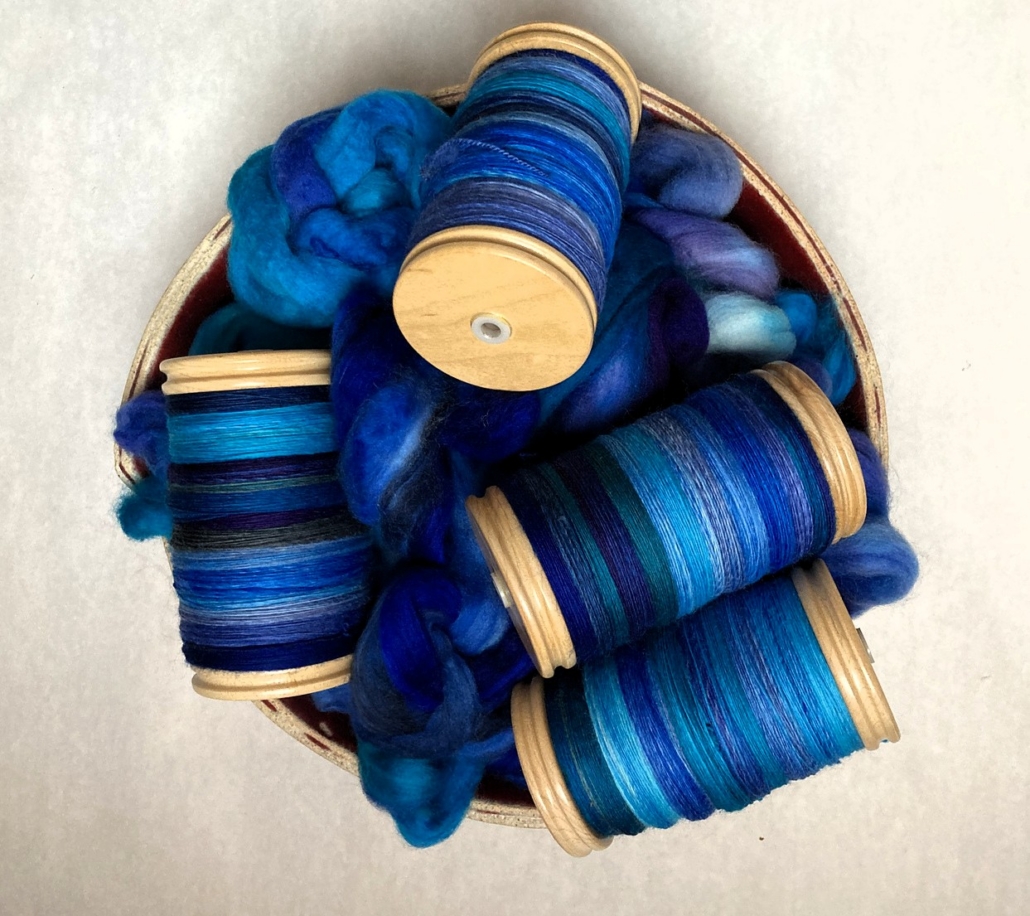
These bobbins will, one day, turn into matching sweaters for my children and their cousins. This combo spinning project yielded approx. 3000 yards of 3-plied yarn, from 921 grams of superwash blue, black, and turquoise merino mill ends, dyed by Fiber Pusher Fairy in Gatineau, Quebec, Canada.
A reflective twist on combo spinning: Intentional gradient, take one
While combo spinning may provide a delightful opportunity to reduce one’s fiber stash while exploring new manners of combining colors and textures, all the while enjoying a very creative way of interacting with fiber, I sought out a more deliberate experience this time around.
Four bags of superwash merino mill ends of different colors (yellow, red, burgundy, purple) had made their way into my stash and I was struck by the idea of spinning them together. I’ve always loved gradients and believed there was a way of turning these mill ends into one. I jotted down some thoughts and devised a way that could, perhaps, lead to such an outcome. It was upon drawing the three separate plies and coloring them in their own colors that the process became clearer to me.

In order to gradually move from one color to the next, every color goes from 3, to 2, to 1 ply per 3-plied yarn.
For example, the transition from yellow (Y) to red (R) to burgundy (B) to purple (P) goes as such:
Skein 1: (Y)(Y)(Y)
Skein 2: (Y)(Y)(R)
Skein 3 : (Y)(R)(R)
Skein 4 : (R)(R)(R)
Skein 5: (R)(R)(B)
Skein 6: (R)(B)(B)
Skein 7: (B)(B)(B)
Skein 8: (B) (B) (P)
Skein 9: (B) (P) (P)
Skein 10: (P) (P) (P)
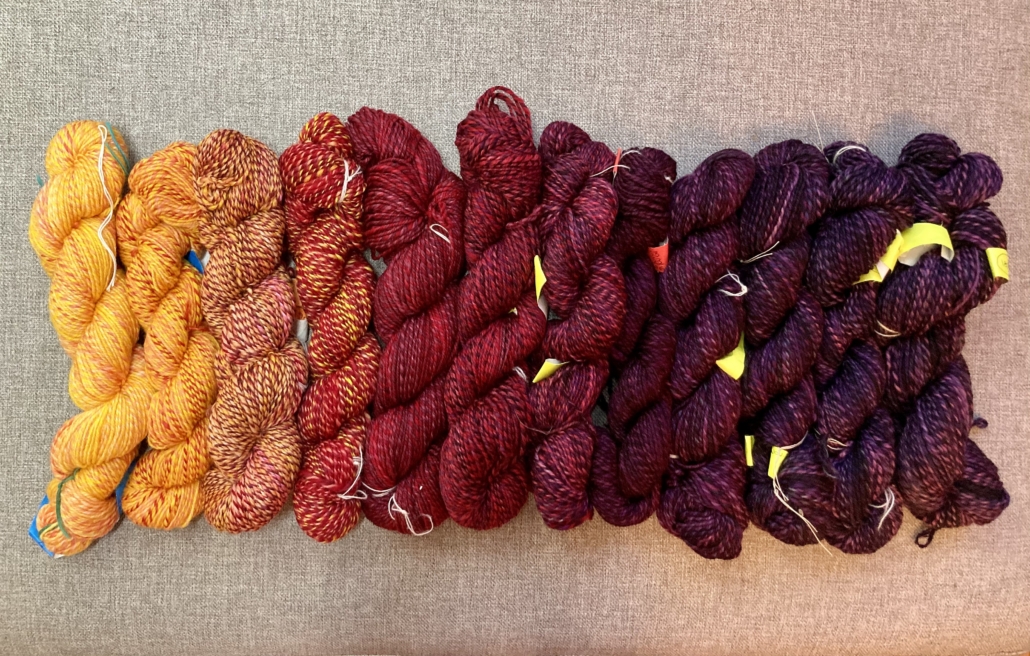
For this first attempt, every mill end bag contained approximately 200 grams of fiber (Y: 192 g; R: 184 g; B: 213 g; P: 192 g) and each was separated into nine fiber bumps of approximately equal weight (21 g; 20 g; 23 g; 21 g). The bumps were spun as singles on three different bobbins and three-plied according to the color progression presented above, shifting gradually from one color to the next. To make the spinning process as smooth as possible, the bumps were kept in numbered baggies containing the three colors necessary for every skein. I spun one baggie at a time, one bump per bobbin, using my trusty Jensen Tina wheel. I then plied the three singles together using my Schacht Matchless.
The overall process took me from September to December 2024, spinning and plying here and there. It made for a very pleasant spin, respectful of my time and energy, as the baggies were relatively small, and my life was very full then! The baggie system made gradient combo spinning very manageable and allowed for quick bursts of mindful creativity in an otherwise busy schedule.
The result proved quite lovely, color-shift wise, and provided a total of 1944 yards from 781 grams of fiber.
| Skein | Composition | Yardage |
| 1 | (Y)(Y)(Y) | 160 yds |
| 2 | (Y)(Y)(Y) | 146 yds |
| 3 | (Y)(Y)(R) | 196 yds |
| 4 | (Y)(R)(R) | 152 yds |
| 5 | (R)(R)(R) | 152 yds |
| 6 | (R)(R)(B) | 174 yds |
| 7 | (R)(B)(B) | 184 yds |
| 8 | (B)(B)(B) | 106 yds |
| 9 | (B) (B) (P) | 170 yds |
| 10 | (B) (P) (P) | 174 yds |
| 11 | (P) (P) (P) | 144 yds |
| 12 | (P) (P) (P) | 186 yds |
A second take on an intentional gradient
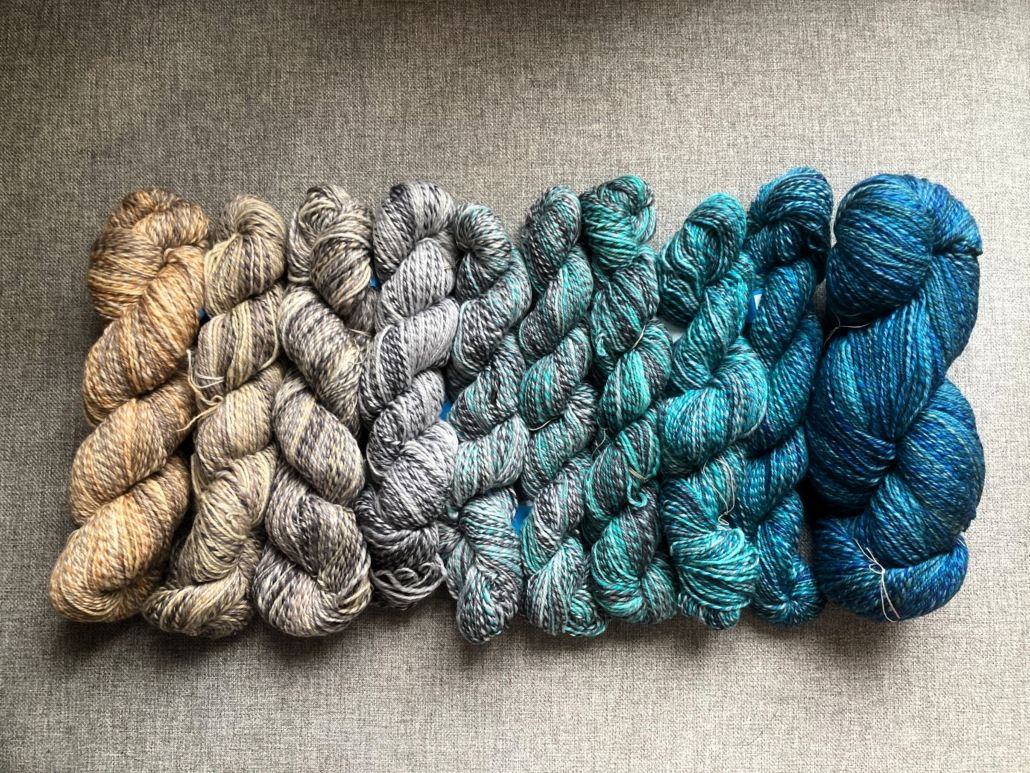
I truly enjoyed my first intentional gradient combo spinning experience and decided to give it another go, beginning in mid-February and ending in mid-March 2025. Once again, I dug into my stash of colorful superwash merino mill ends. My goal this time around was to use up as much of the fiber as I possibly could, minimizing leftovers.
To achieve this goal, I weighed every bag of mill ends carefully:
Beige (Be): 177 g
Gray (G): 184 g
Sky (S): 146 g
Dark blue (D): 250 g
I maintained the shifting color sequence described above over a three-plied yarn. However, instead of dividing my mill ends into 9 bumps of equal weight per color (which made for larger bumps for some colors than others, and therefore, more remnants), for this project, I changed the weight of the color bumps forming each skein to that of the color I had less of for that given skein. This approach was successful in using up most of my fiber. When I had more fiber in one of the initial colors (such as D), the leftovers were added into the skein containing three plies of that color.
Here is how it went:
| Skein | Composition | Weight of each color bump | Yardage |
| 1 | (Be)(Be)(Be) | 19 g, plus leftovers | 288 yds |
| 2 | (Be)(Be)(G) | 19 g | 176 yds |
| 3 | (Be)(G)(G) | 19 g | 180 yds |
| 4 | (G)(G)(G) | 20 g, plus leftovers | 172 yds |
| 5 | (G)(G)(S) | 16 g | 155 yds |
| 6 | (G)(S)(S) | 16 g | 144 yds |
| 7 | (S)(S)(S) | 16 g, plus leftovers | 150 yds |
| 8 | (S) (S) (D) | 16 g | 162 yds |
| 9 | (S) (D) (D) | 16 g | 146 yds |
| 10 | (D) (D) (D) | 28 g, plus leftovers | 486 yds |
I achieved my goal of including as much fiber in my project as possible. The leftover singles were minimal.
Some colors are more present than others in my second attempt, which makes for a different gradient than my first. Both are equally interesting and would make for wonderful projects. I’d like to knit myself a long cardigan out of this first intentional combo-spun gradient, and a woven blanket would be lovely out of the second.
I hope this process inspires you to create your own intentional gradient by teaming up single braids into a cohesive project that inspires you.

Textiles have been part of Gaelle’s day-to-day since childhood. She quilts, spins, weaves, and dyes in Montréal, Québec, surrounded by animals, children, and fellow artists.


Leave a Reply
Want to join the discussion?Feel free to contribute!