
Mixing Things up for a Sweater
words and photos by: Johanna Carter
I always admire those who are able to spin mountains of yarn for a big project, ready to knit a wonderful sweater or cardigan. It is a satisfying feeling when you finish all that work, especially if you started with washing and combing the wool or even raising your own sheep.
Mixing spinning and knitting
The typical way to work through a larger project is to spin all the singles first and ply them in a particular order so you get the yarn even throughout the whole project. I don’t have so many bobbins, but my bigger problem is that I am quite impatient and want to get on with knitting once I have an idea. And normally, my brain is full of ideas for fibre work and the limit is the time, as I am a musician and teacher. I can’t sit at the spinning wheel for a long time if I’m not on holiday, so during the school year I mostly knit, and during the holidays I can dye, spin, use my drum carder, and do lots of fibre work. The only time I was able to produce bigger quantities of yarn before I knitted them up was during the Tour de Fleece in the two years during the pandemic, when we did not go on holiday at the beginning of July.
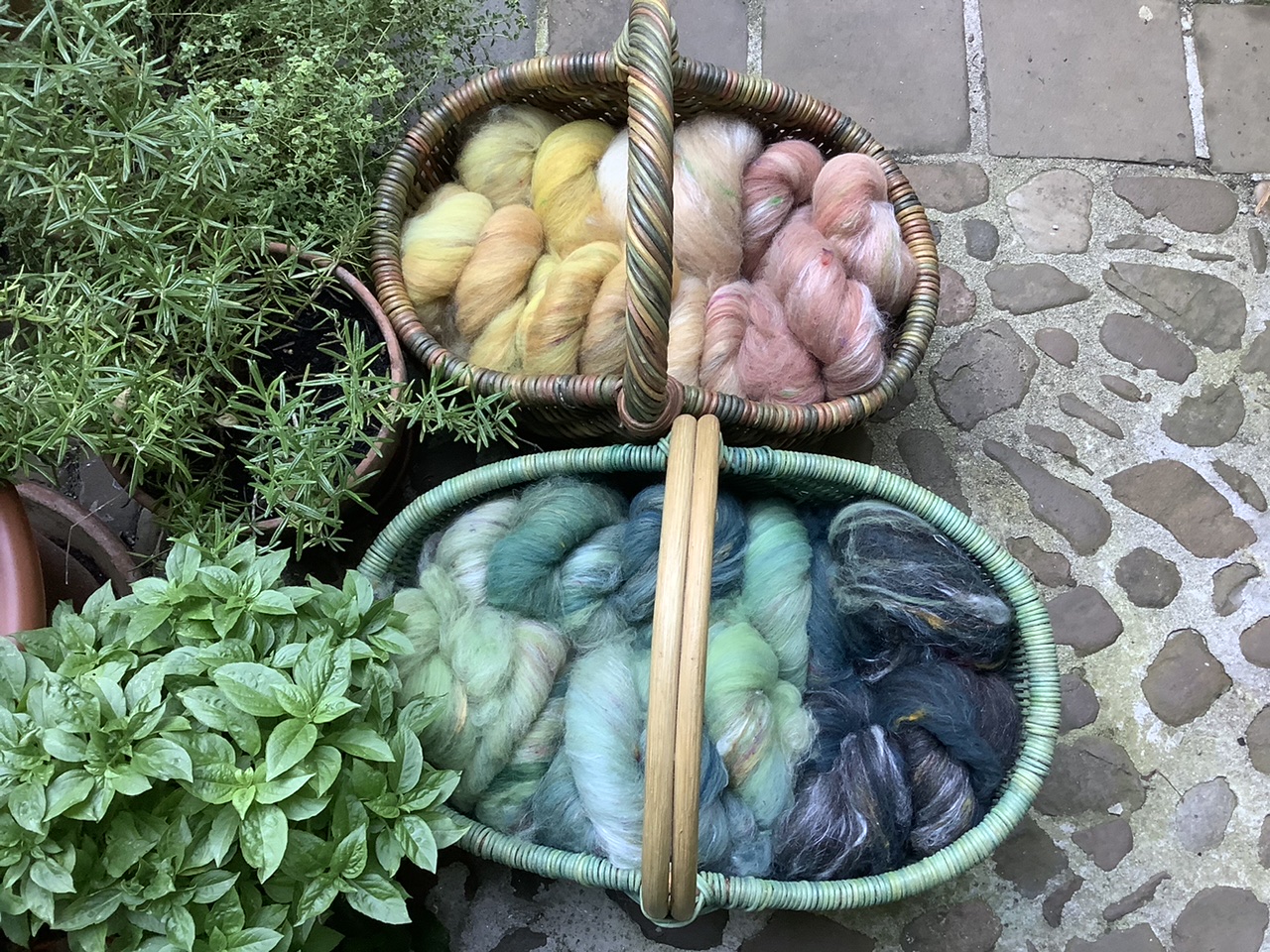
A highly photogenic collection of naturally dyed fibres.
I like to finish knitting one big project like a sweater or cardigan before I start the next one, or at least until I can’t carry it in my bag easily anymore, so I have an excuse to begin the next one. Sometimes it is good to have a second project on the go – I call it mindless knitting, where I don’t have to look very much – which I can keep my hands busy during Zoom or other meetings, which helps me listen.
Mixing colours and fibres
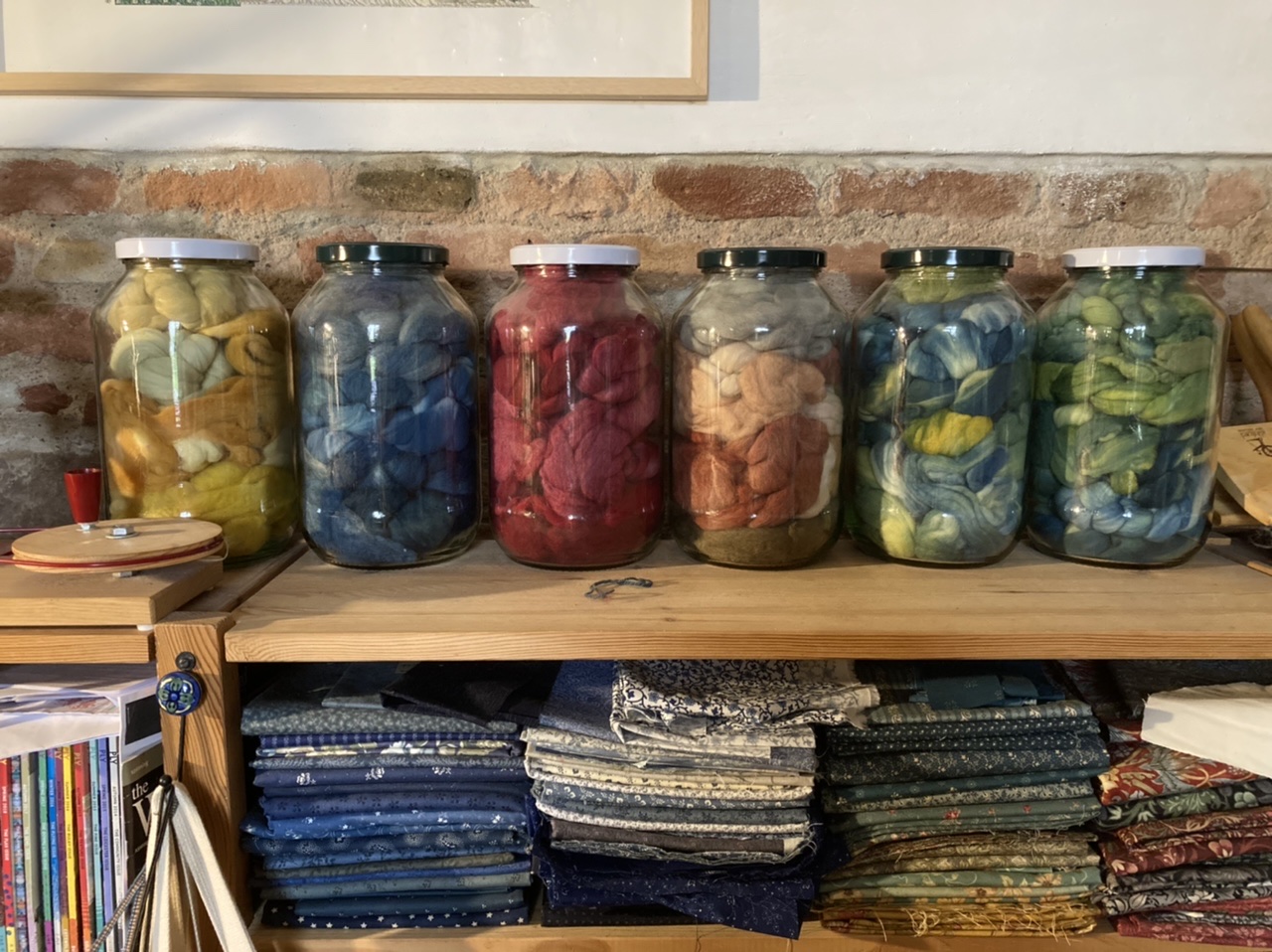
Usually I dye my yarn with plants which I collect in the woods or get from garden flowers. I also use cochineal and indigo, which I buy, to get lots of different colours. I really love the greens and blues I get from dyeing with indigo. I have lots of dyed wool, and all those colours give me inspiration for further projects.
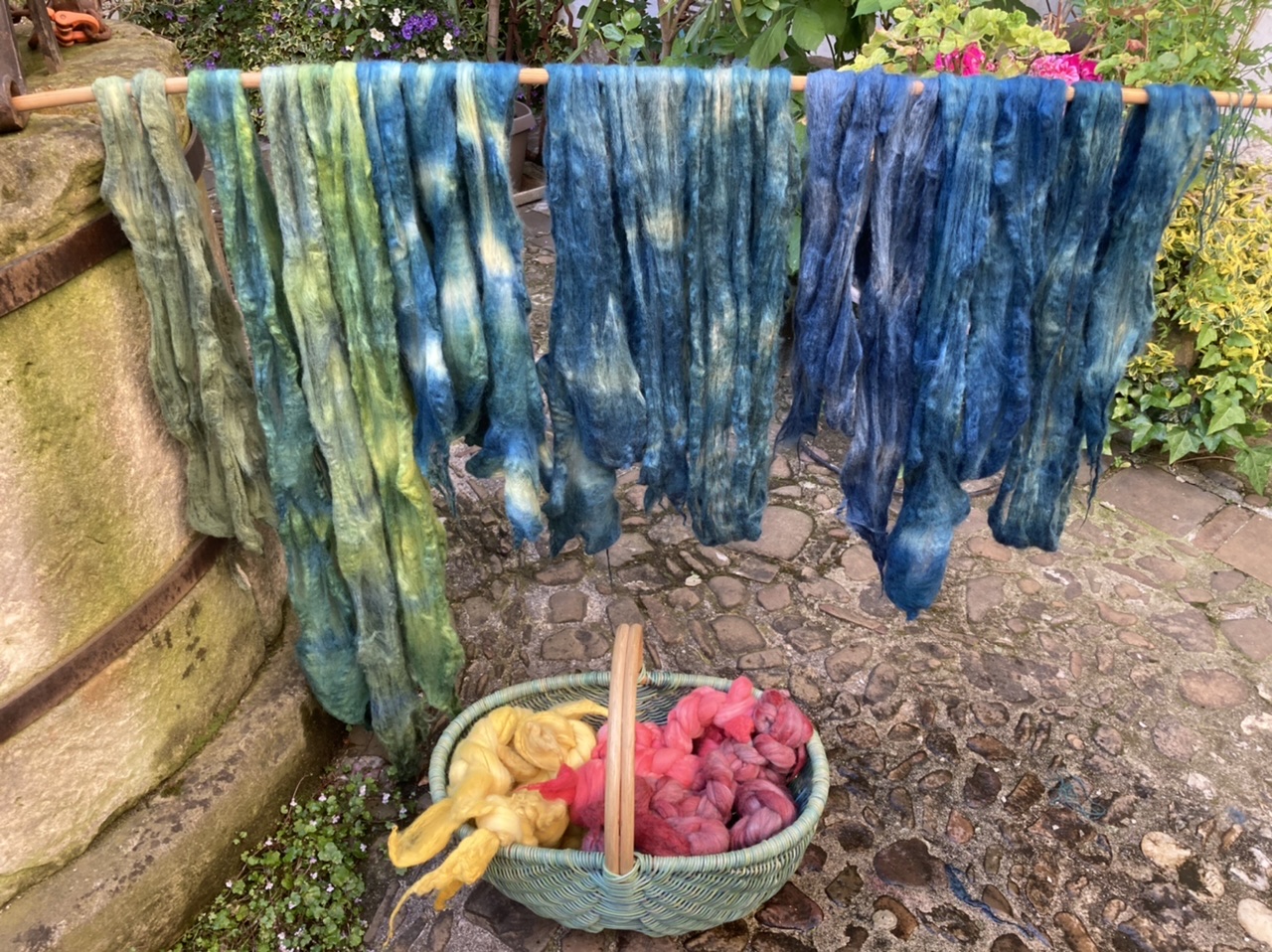
Beautiful greens and blues dyed by the author using indigo and other natural dyes.
Blending the wool on the drum carder I can get even more shades. I like to blend with fibres like silk, alpaca, or plant fibres, and I love sari silk, to get those little bits of colour in my yarn.
Fibres of different types and colours are blended on a drum carder for elegant results.
When I have an idea for the next sweater, I start carding, and then I can begin to spin. Once I have spun enough yarn – say, for one day – I cast on and start knitting, usually top down, so I don’t have to decide too much in advance about length and width.
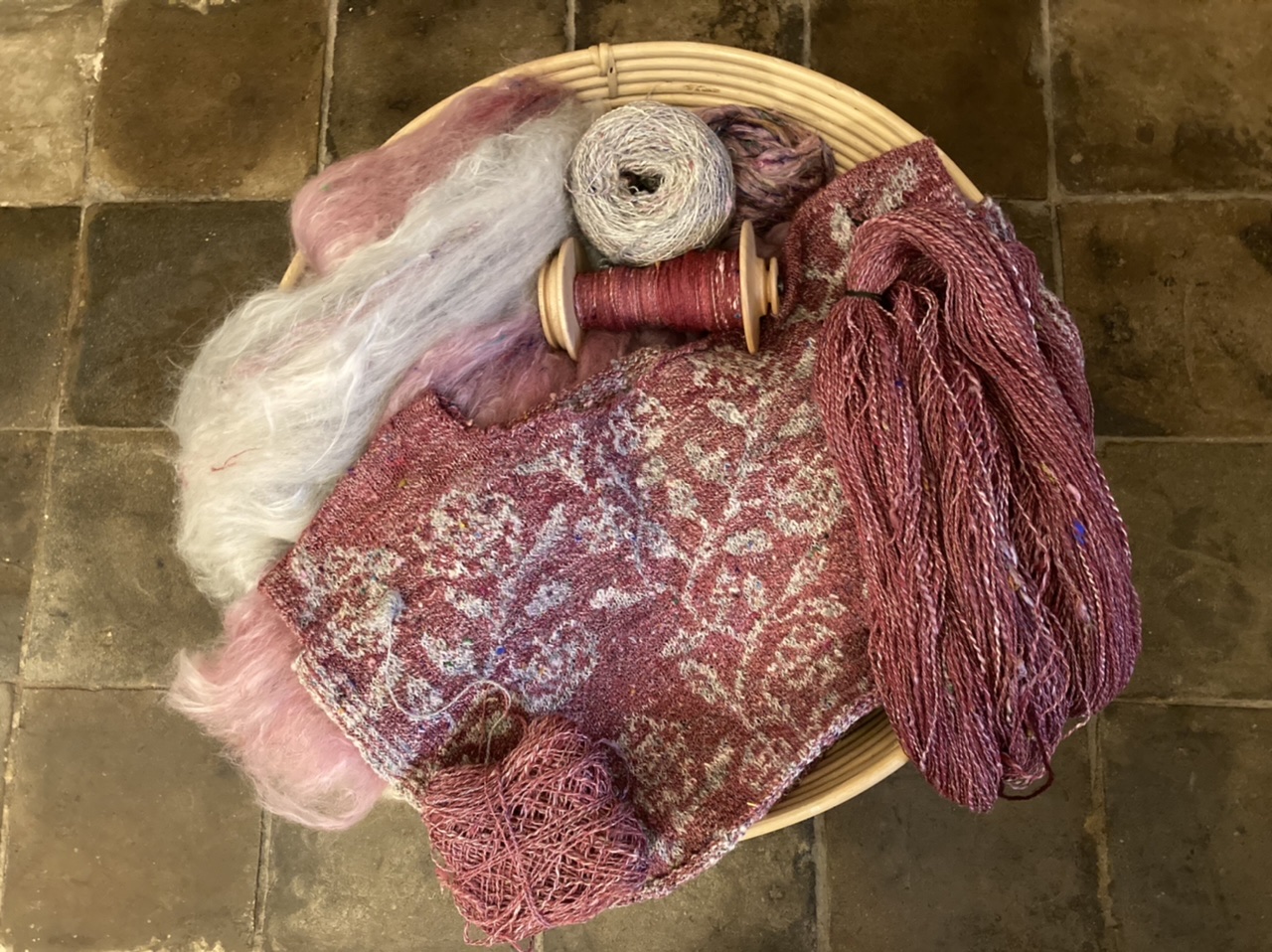
An idea for the author’s next sweater in the gathering stages.
When I spin on my wheel, I have to sit at home, but while spinning I can read a book or talk to others during online meetings. I also like to spin on my spindles, and that works on a walk, or a museum visit. I take them on holiday as they don’t need much space, and when I spin for a lace shawl, I don’t even need much wool either. At home there are spindles all over the place; I can spin when I am waiting for the kettle to boil, when the computer is slow, when I am cooking. Like that I can make good use of a short time and the yarn still grows.
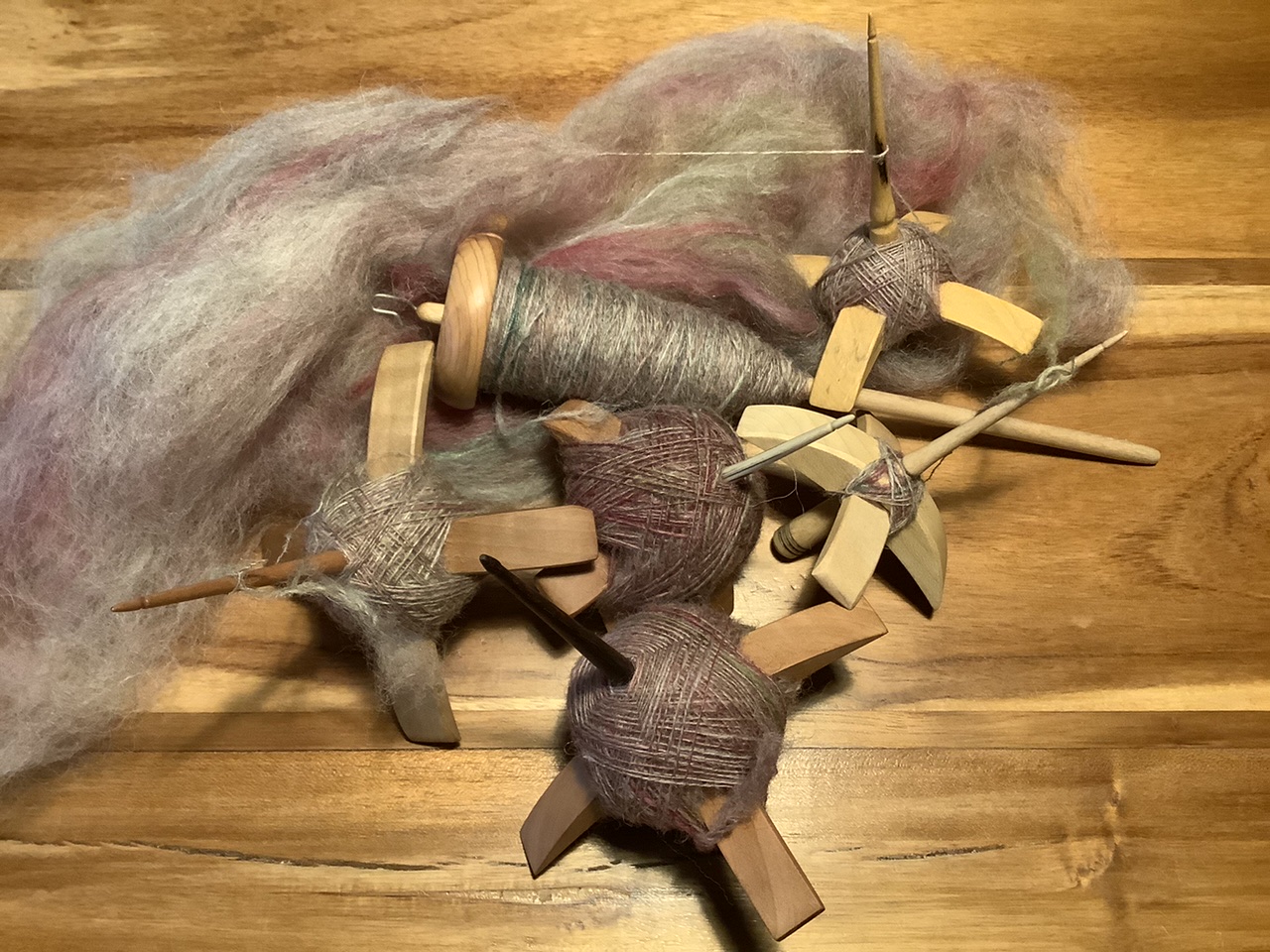
Knitting as soon as the yarn is spun helps the author complete sweater projects in a timely manner.
I can take my knitting almost everywhere, which is why I don’t want to wait to get started until I have spun all the yarn for a whole sweater. I knit at home, on the bus or train. The only thing I have to make sure of is to be one step ahead with the yarn.
I love to knit Fair Isle sweaters. My favourite method is to use only one bobbin, which I don’t even fill, because I need smaller quantities of lots of colours. Then I wind a ply ball and ply it on itself. For that I put my thumb through the ball, so I can tension the two singles with my fingers and they don’t get tangled, as long as my thumb (or a cardboard roll or a pencil) stays in the middle. I don’t have any leftovers from plying, and it is quick when I suddenly need more yarn.
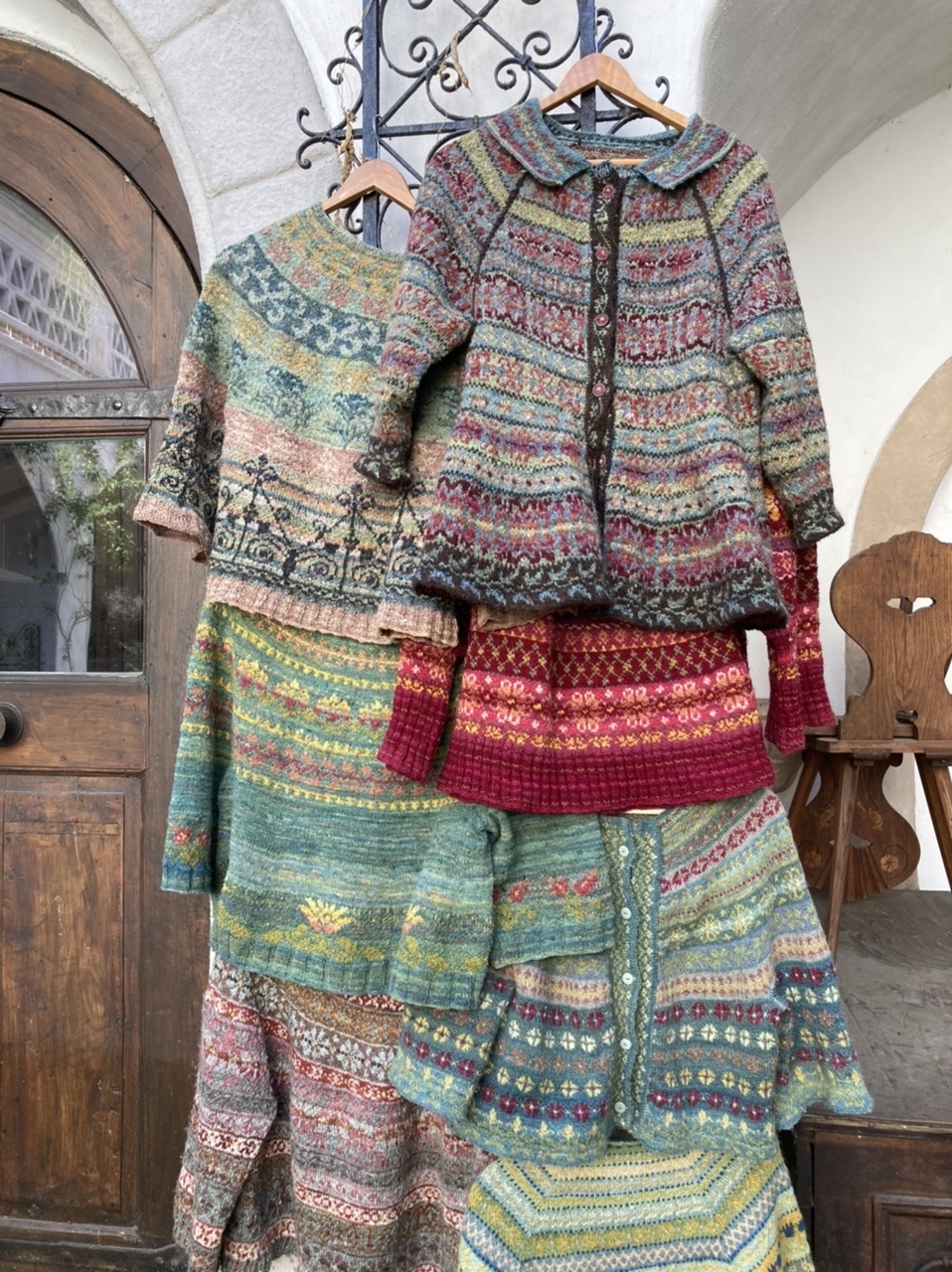
Several charming sweaters dyed, spun, and knit by the author.
I have never had problems with the yarn not being consistent enough throughout a project. I just know what yarn I want and my fingers seem to remember what to do. I am sure it is good advice to have a little card tied to the spinning wheel with a bit of the singles you are aiming for, so you can check and make sure you are spinning a consistent yarn.
Mixing breeds
There are so many different breeds, but some of my favourites are Shetland, BFL, and Jämtland – a Swedish breed. After dyeing them, I often forget what I have used, so when I do a new project it often turns out that I have used different breeds and fibres just to get the right colour. For the Fair Isle knitting I want to juggle lots of colours, which is more important to me than making a sweater out of only one breed.
Recently I made a pullover for my husband using about 12 different breeds and colours, even mixing short and long draw. For me it was a breed experiment and a way to use up lots of smaller quantities of wool I had in my stash. For that sweater I used combed top without blending.
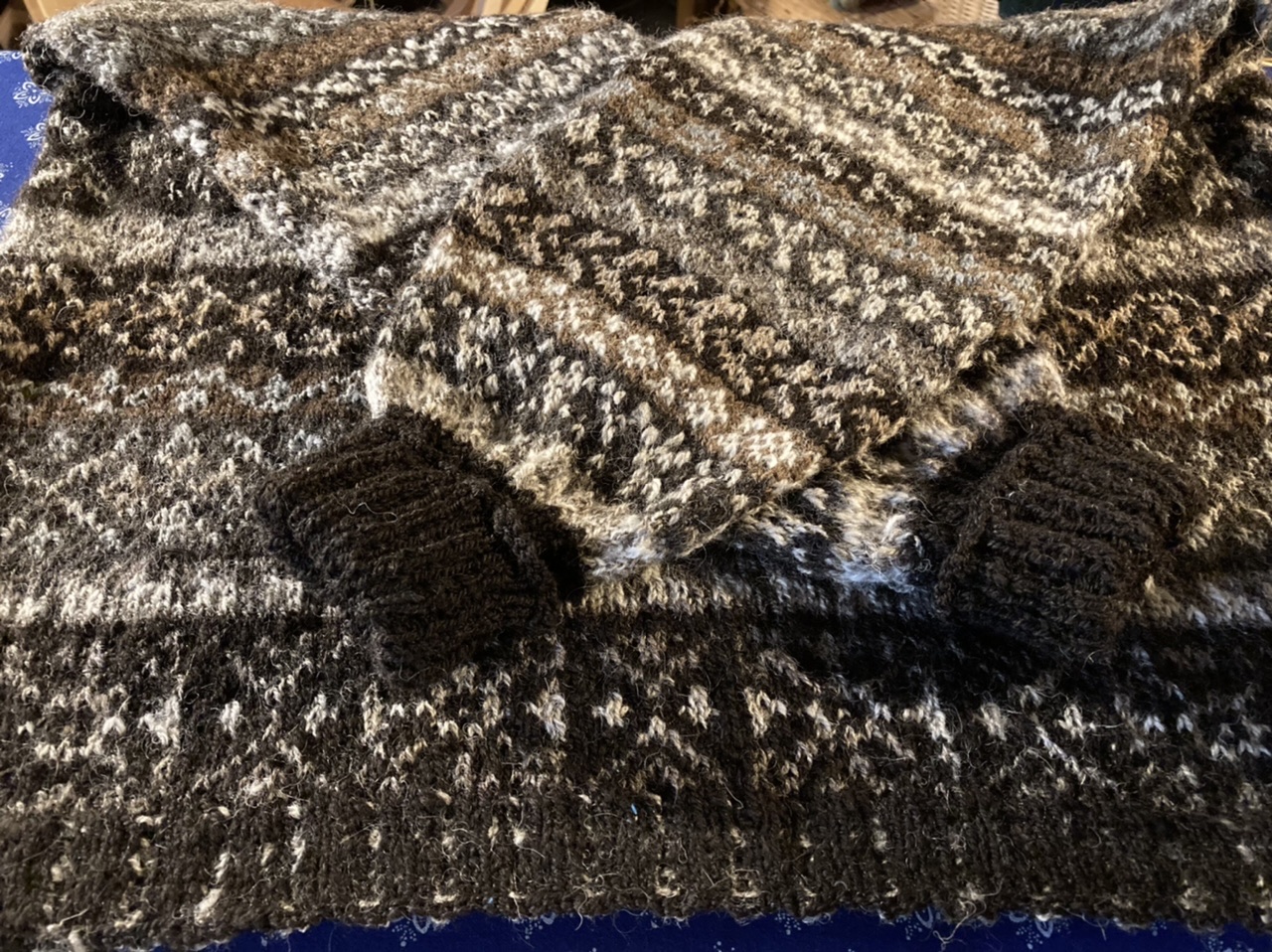
Mixing in knitting during the spinning process is a wonderful way for a spinner to avoid being overwhelmed during a sweater project.
My feeling is that some people don’t dare to start spinning for a bigger project because they get overwhelmed by the quantity they have to spin and then all the knitting there is to do, especially when you want to spin the yarn entirely on spindles. Mixing the spinning and knitting for the same project is more interesting; you get more variety and more freedom to choose what you want to do next as long as you don’t run out of yarn. It breaks the project down into smaller, less daunting parts. The only thing you might want to plan is to have enough fibre at the start, but even that is not necessary, there is always a sheep growing more wool.
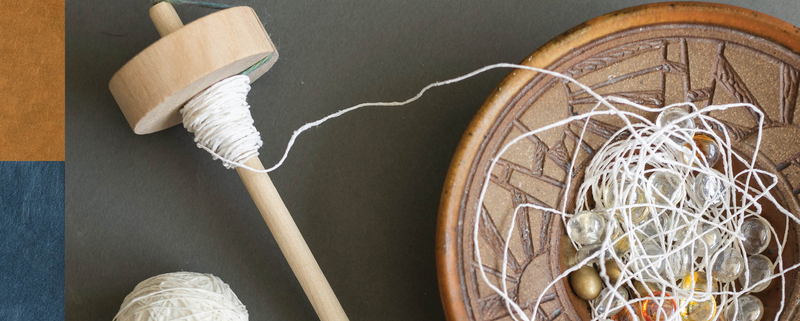
Book Review: Japanese Paper Yarn by Andra F. Stanton
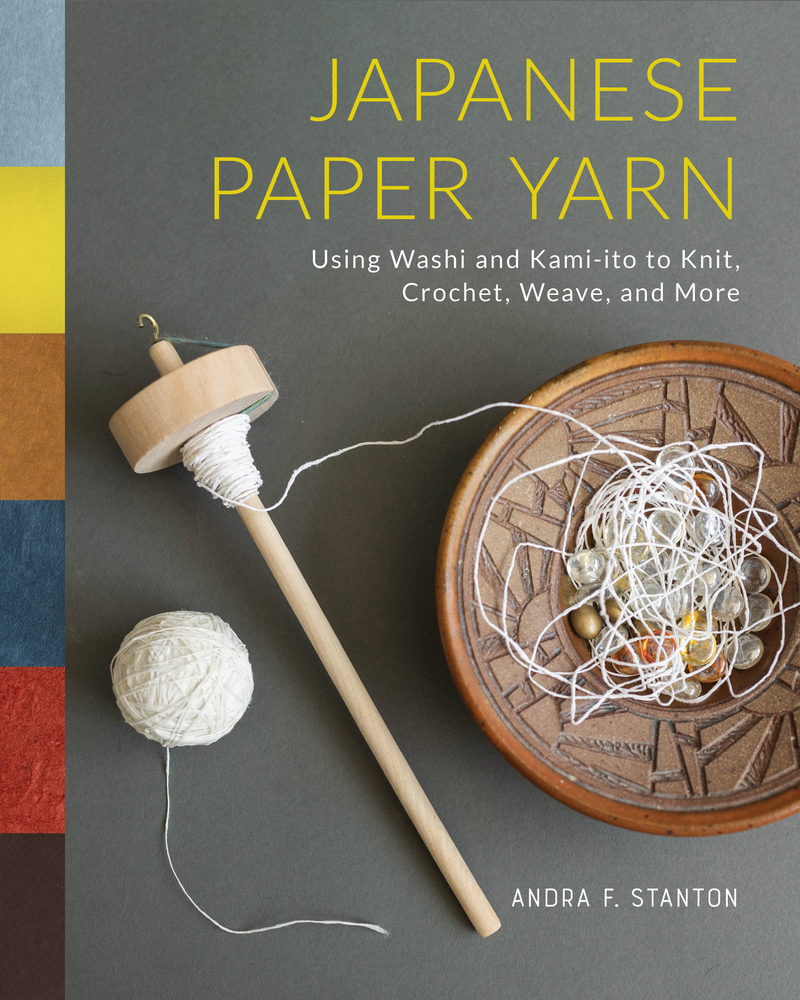
Japanese Paper Yarn: Using Washi and Kami-ito to Knit, Crochet, Weave, and More
by Andra F. Stanton
Schiffer Craft
$26.99, Hardcover, 96 pages
Published: November 28, 2024
Buy now at Bookshop.org
Reviewed by Meagan Condon
If there is one truth I’ve learned through the years, it is that the people who love yarn and the people who love stationary/pens … are actually the same people. There is something about these two mediums that speak to the same primal, creative impulses in us. But what happens when we consider where these mediums overlap one another?
Released in November 2024, just before the holiday season, Japanese Paper Yarn: Using Washi and Kami-ito to Knit, Crochet, Weave, and More by Andra F. Stanton is a engaging read for papermakers and handspinners alike.
Kami-ito is the Japanese art of turning washi paper into thread or yarn. If you think, as I did coming into this read, that paper is a weak material, think again! Japanese washi paper is made from the inner bark of kozo mulberry, which contains long, strong fibers that are preserved through the papermaking process. The finished paper is turned into strips and is then twisted to form a fine thread.
Stanton first introduces the reader to the history of Japanese paper and paper yarn, including how paper yarn was used to create clothing. She explains in suitable detail the process of making washi paper from kozo and how to prepare that washi for spinning. Because many of the materials used in the projects can be difficult to find in Western countries, Stanton clearly names these materials and includes several sources where materials can be purchased, including already spun kami-ito.
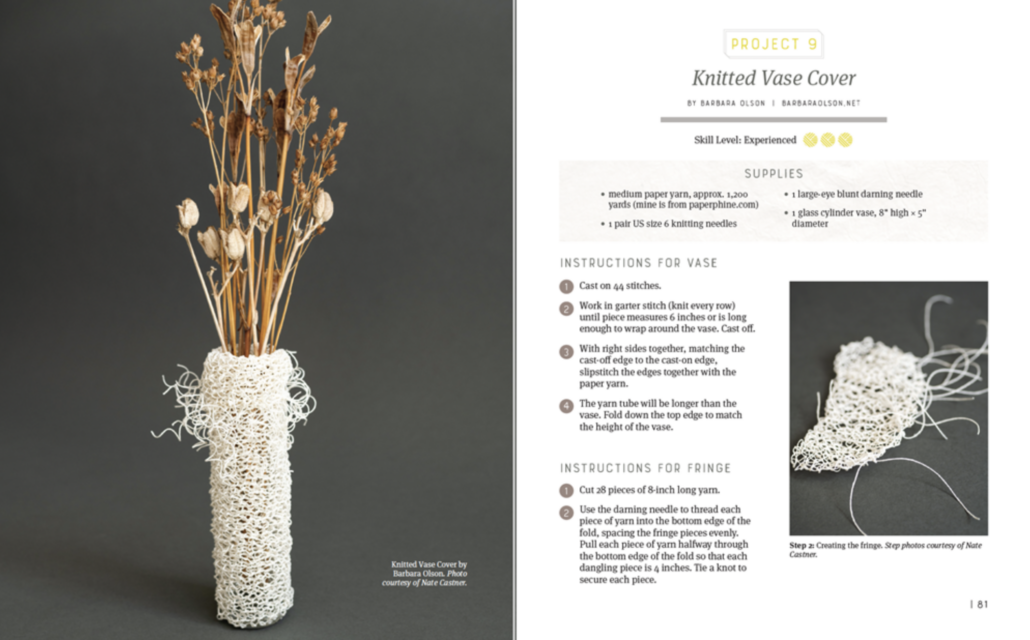
The book continues with 12 projects that range from novice to intermediate difficulty. Not only do the projects range in skill, they also incorporate a variety of inspirations and partner crafts, like knitting, weaving, crochet, bead-making, and knotwork. Stanton does a great job showing the range of what can be done with paper yarn!
By far, the best part of this book may be the beautiful, full-color photographs of original paper yarn creations by dozens of contemporary artists. The art featured in the book coordinates with the projects and showcases the skills taught in each project. It had me flipping back and forth comparing the art to the projects and “ooh”ing over how this or that art piece used this or that skill.
This may be the technical spinner and process crafter in me, but if there is one piece I craved more of in this book, it is details on the process of spinning paper yarn. Chapter 4 covers making both washi and kami-ito. It gives a beautiful description of how to prepare the washi for spinning but expects the reader to come to the text with a basic understanding of how to spin. I would have loved to get some trouble-shooting tips on the spinning process!
While there are more detailed texts available that speak to the history and practice of making paper yarn (such as Kigami and Kami-ito by Hiroko Karuno), Stanton’s book may be one of the most accessible for Western audiences. It gives the reader enough information to whet their appetite and stretches the imagination on what can be done with paper. If you crave texture in spinning, kami-ito may be the next big stepping stone in your spinning journey.
Celebrating Risks
Words and photos by Wendy Emo
I’ve spent the past two years taking risks with my spinning. While some of my new yarns are lovely, many did not turn out as I’d hoped. I processed and spun new-to-me Teeswater and Wensleydale fleeces (culminating in one amazing tunic and several duds), tried new spinning techniques (bouclé, cloud, and lockspinning, which all worked), attempted dyeing (I definitely did not get what I expected), persevered during a challenge project from my guild (this made me bananas for at least a month during all the spinning and knitting “fails” before the project ultimately turned out well), knit alternating strips of sari silk fabric with handspun (yuck for the first go, that’s for sure), and subbed last-minute as a three-day spinning workshop teacher (the flurry and fiber explosion in my studio were impressive, and I certainly had fun).
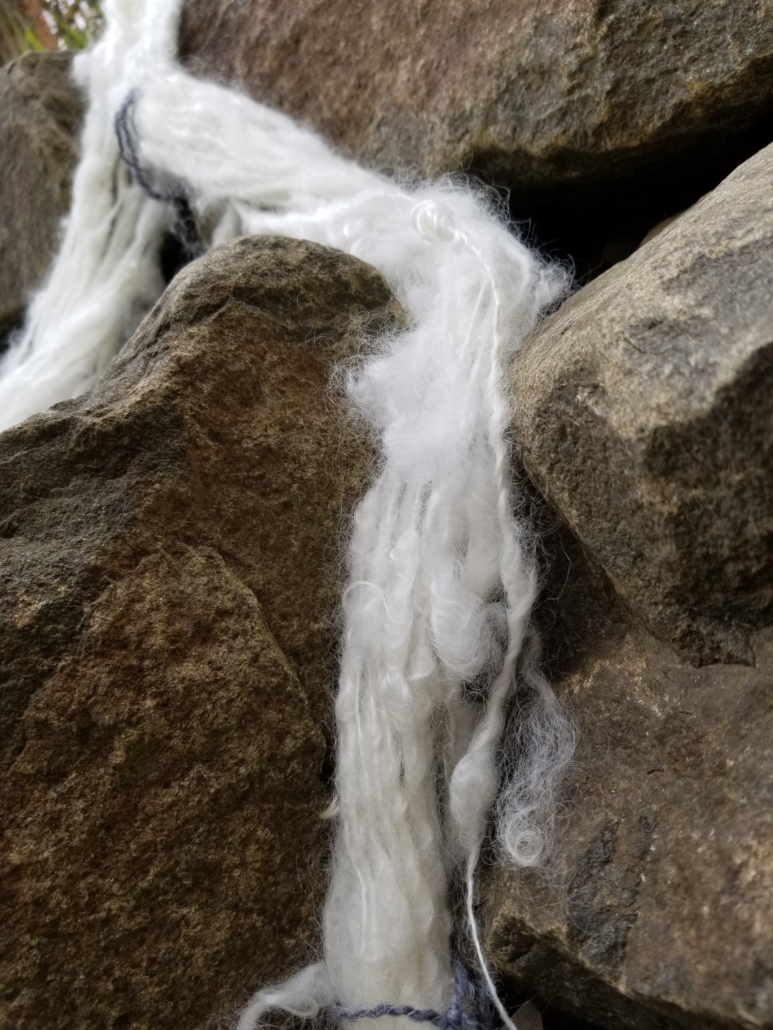
I’ve discovered that I need to celebrate my attempts at the new and different. I sell items at a gallery, and a few types of items sell fairly well. When I explore and challenge myself, I’m taking time away from production of the “known,” so that’s a bit of a risk (even though the income isn’t high, the gallery needs stock). On the other hand, sticking with the known risks boredom. Spinning what is easy and known is relaxing, but then I don’t learn a new skill.
Challenging myself sometimes results in discouragement to such an extent that I don’t even want to look at my wheels or fiber stockpile. I’m not confident with combining color. When the guild passed out random bundles to spin for a gift exchange, I couldn’t imagine how to put together dark purple, pale pink, and baby blue in any way that would make something I’d want to give to anyone, let alone another artist. I avoided my wheels for five full days after that. When I realize that I’m intentionally not spinning due to discouragement, I need to take care of myself rather than avoid my fiber stash in favor of the chocolate stash. In this case, my emotional self needed some encouragement, but the project turned out well in the end.
Other artists also notice this connection of emotional reactions to one’s creations. I overheard a painter suggest to another artist that she focus on what she does like in a problematic piece rather than making a broad blanket statement about not liking it. I figure that this is great advice for taking care of myself as a spinner. If I identify the positive attributes of my art, I then have changed my outlook. Perhaps I can think of the challenging colors differently, such as reminding myself that maroon and light blue sometimes show up in the morning and evening skies. This then might inspire me to add an additional color to tie them together.
Naming the positive attributes of my ineffective experiments resembles changing a mindset. I tend to think of Merino/silk top as meant exclusively for fine-spun worsted yarns. When I followed my maxim and made a 2-ply yarn intended for a lace scarf, the gorgeous top of pecan-toffee-caramel* became a “ho-hum” light brown without the lovely subtle shades. The remaining singles sat abandoned and ignored in my studio, and I went off to a workshop with Judith MacKenzie.
Judith had us spin both eri and muga silk (singles). These were so exquisite to spin that I left these bobbins alone even after Judith encouraged us to use them. When I finally needed these bobbins, I remembered her suggestion to try the singles in plying. The silk singles were close to the same weight and in complementary tones to the toffee singles. I decided to ply the silk and toffee together. The addition of the extra silky shimmer and two tones brought out the best in the singles. The finished yarn shows the different response the two singles fibers had to the rinse, but I was after a good color effect rather than a completely smooth yarn. Those pecan-toffee-caramel tones glow in the yarn. Not only did I have to recognize the positive attributes of the singles (even, fine, great color, nice hand), but I had to do something different. I don’t think I would have experimented with silk singles without the encouragement of another spinner. It wouldn’t have occurred to me.
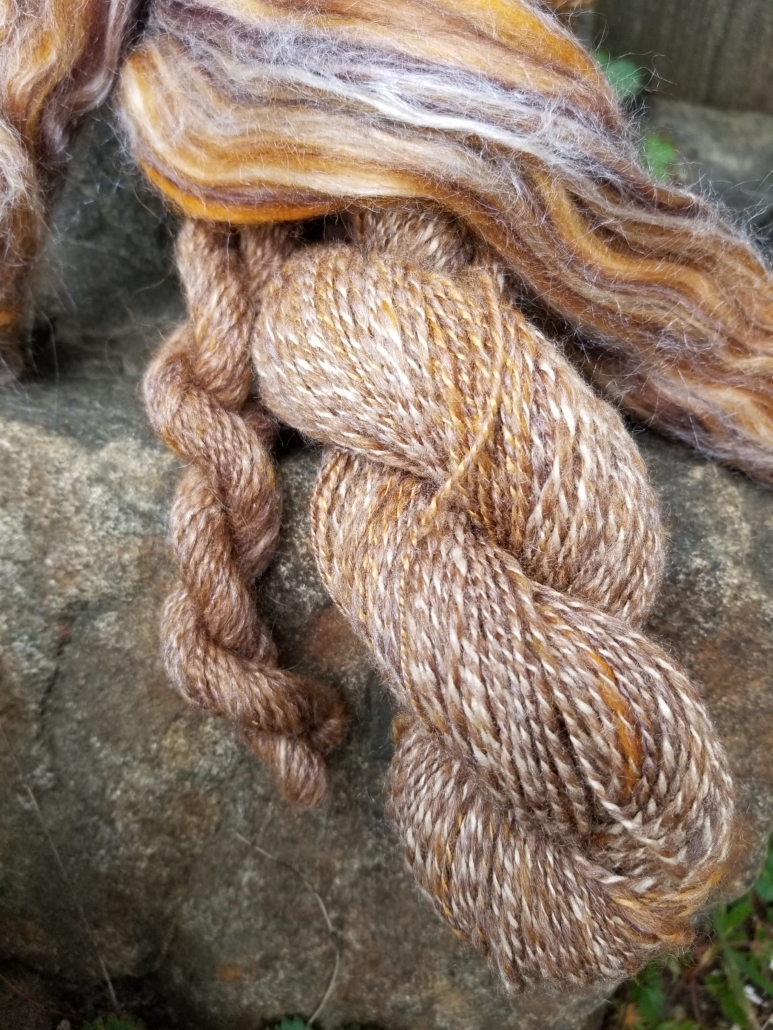
Other spinners contribute to my self care, not only in suggesting new approaches but also just in sharing our creations. Celebrating the triumphs and sharing the funny mistakes is such an encouragement. One day recently I made a 3-ply skein of dark BFL, the first part of a fleece I hoped to have all spun before the next festival. I was pretty pleased with it until I finished it and discovered I had overplied it. Judith MacKenzie says that yarn judges can tell from looking at a yarn if a spinner was stressed while spinning. I had been watching Pirates of the Caribbean while plying. It showed in the yarn that I must have been anxious for Orlando Bloom’s life during all that swashing and buckling, even though last time I watched the movie, he was safe.
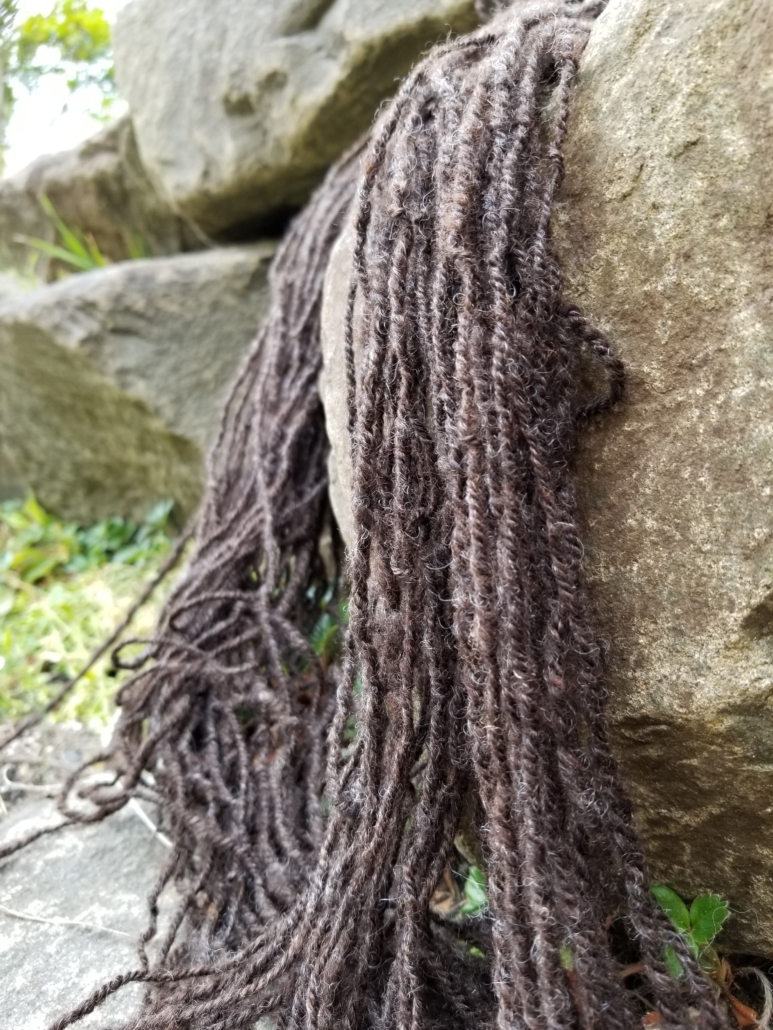
My favorite mistake yarn, however, is “Going the Wrong Way” – a very elastic energized yarn I unintentionally plyed the wrong way a few years ago. The skein stretches from about 10 inches to 28 inches, nearly three times its relaxed length!
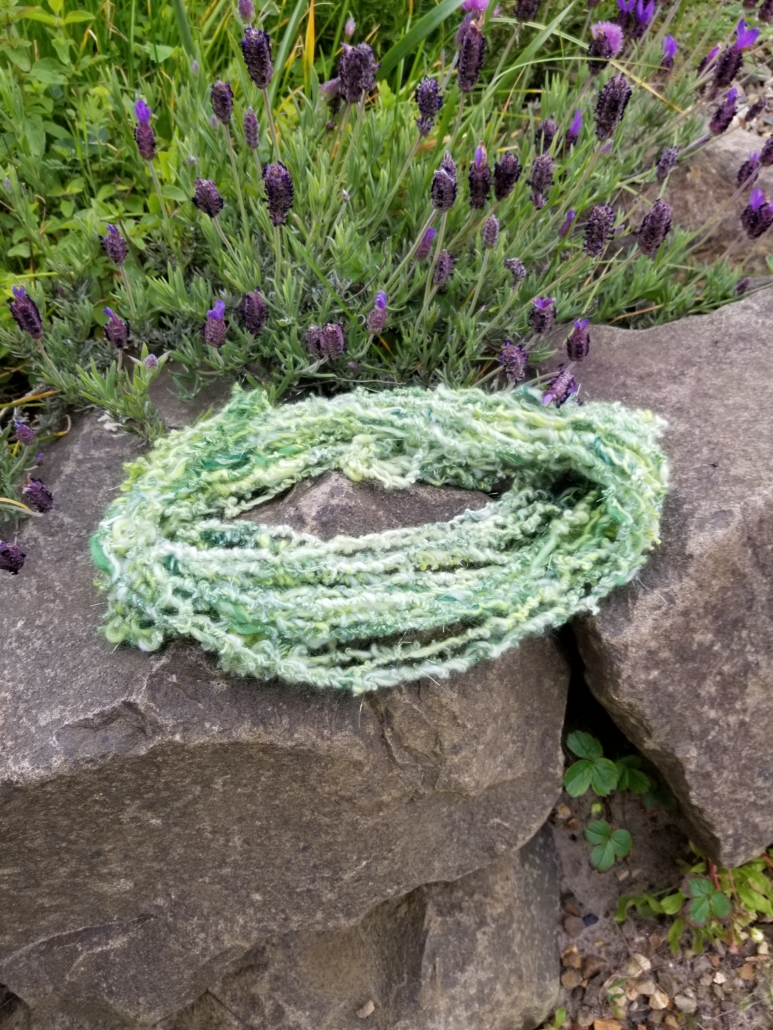
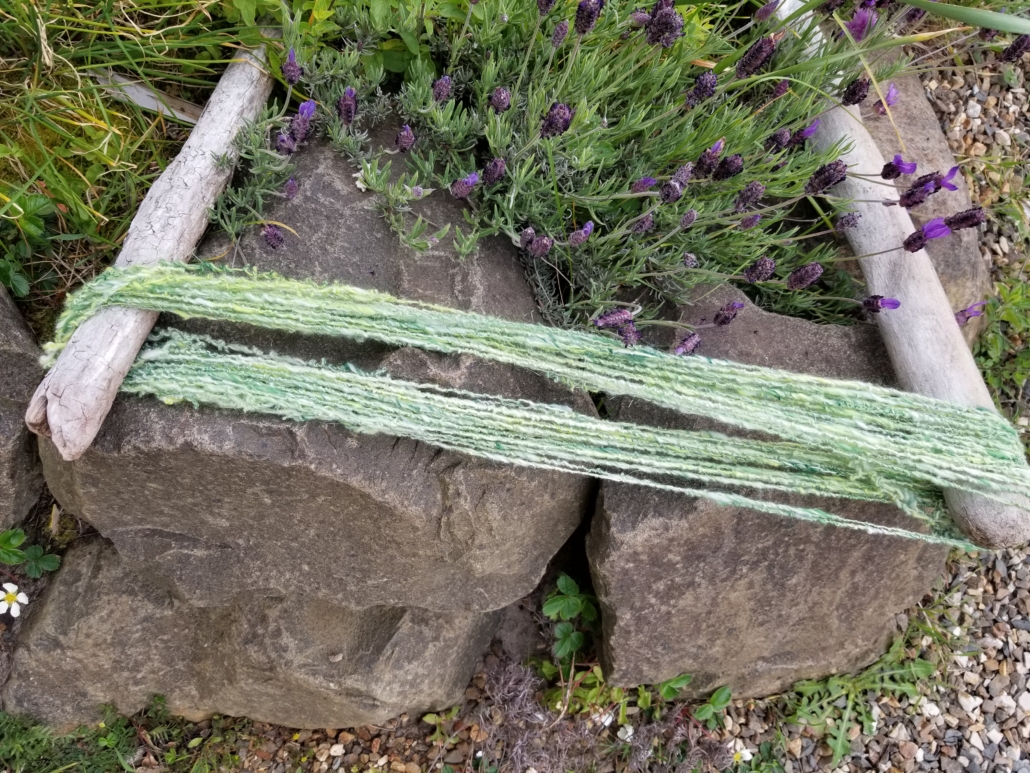
When I share these yarns with others, both “Pirates” and “Wrong Way” always give us a good laugh, which helps me enjoy my mistakes. I was happy to read Jillian Moreno’s comment (Yarnitecture, 2016) that an overplied yarn like “Pirates” probably wouldn’t affect the project I had planned for it – a watch cap for my husband. I may keep “Wrong Way” for posterity.
Celebrating my mistakes and triumphs makes me realize how much I’ve learned about spinning since I started taking more risks. I can understand the technical descriptions in spinning publications, explain them to someone else, and apply them to my own spinning. I now give myself permission to give away fibers and fleeces I thought I’d enjoy but which are not yet “my thing.” I’ve learned that I can make complex-looking yarns, even though I see the flaws which identify them as a learner’s handspun.
I know my emotional self is connected to my physical well-being. When my attitude toward spinning is not positive, maybe I need to get out for a walk. Perhaps I need to change my position at the wheel, check the angle of my legs, notice where my hands and shoulders are, or put a pillow under my seat. It might be that my hands are too close or too far apart. Am I tense? With new fleeces, new ways of spinning, or when I’m trying to spin perfectly, I might be on edge. The first place I notice tension while playing piano is in my right ankle. When I intentionally relax that tension, I usually play better. In spinning, that tension is usually in my hands, and that tension affects my spinning.
My physical self, my emotional self, my intellectual self, and my social self – all of these affect my spinning. Thank goodness for my fiber friends and husband. I share my fails and successes with these people. They sometimes suggest changes and always grin along with me when I share what actually worked. Mostly, when I ask the question “Do you think this will work?” they say, “Just give it a try!”
According to some motivation researchers, we all are likely to stick for a long time with tasks we choose, over which we have some control, which engage our imagination, and whose challenge level is appropriate although the outcome is not guaranteed. If there are social elements to the task, that’s often motivating, but to a lesser degree and not for everyone (the same with achievement recognition and competition). The next time you approach that interesting project, note that you’re taking care of your creative self and motivating yourself just by what you’re choosing to do and how you do it. Celebrate your explorations and share them with others and let us celebrate with you.
*This fiber is known as “Lynx,” a 70 percent Merino, 30 percent Tussah silk blend.
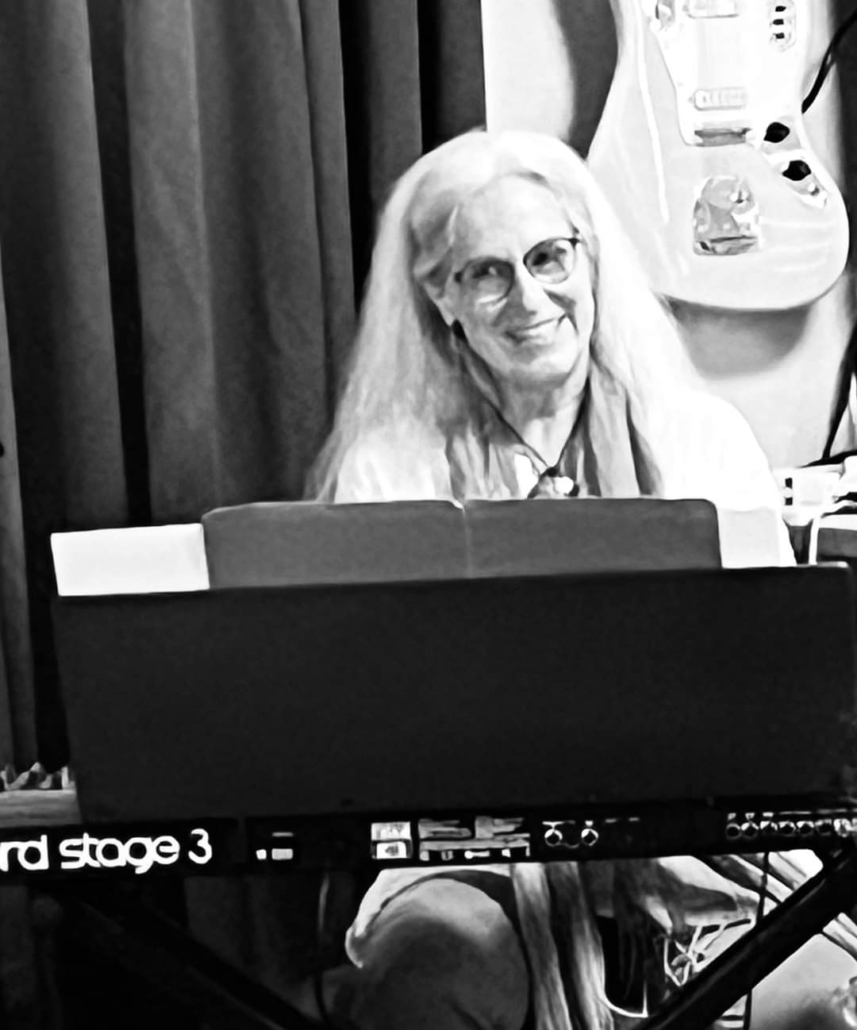
Wendy Emo, PhD, takes risks playing keyboard in open mics, music jams, and a surf band when she’s not finding ways to use up (or add to) her fiber stash.
Trash in; trash out
The art of saving your scraps for another project
words by Meagan Condon
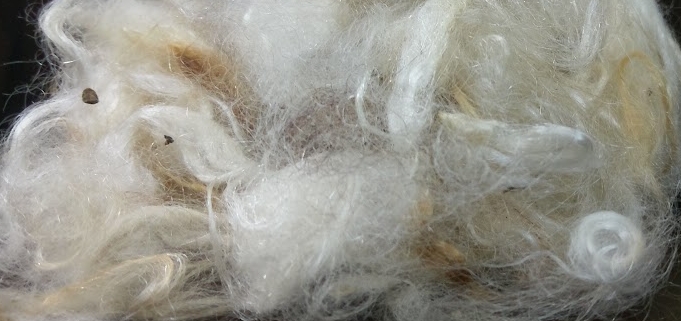
Something many experienced fiber teachers, myself included, try to relate to new spinners is… if something in your fiber supply isn’t working… if you have neps in your worsted preparation… if you have a lock that doesn’t want to spin right… it is okay to toss it! No one ever listens the first time. I remember when I first started spinning, I didn’t want to waste a single tuft of fiber. Fiber is an expensive and precious commodity! I couldn’t bear the idea of tossing anything, even if it was trash fiber. It could have more straw than fiber and I’d still sit down and pick out “the good parts.” That boat has long since sailed for me, and I’d like to help you christen your own boat and explore ways of handling fiber scraps that will improve your spinning projects and clear out your studio.
Rule #1: Trash in; trash out
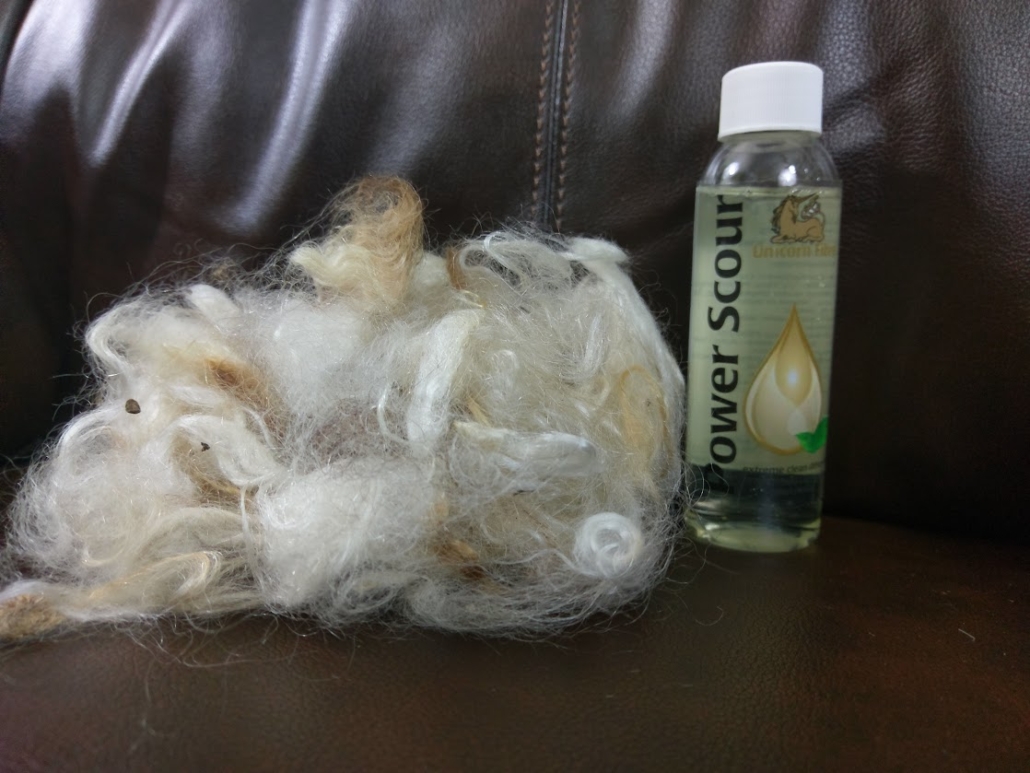
Let’s say you want to create a smooth worsted yarn. You select a nice braid of BFL/silk which you probably paid a nice price for. As you begin to spin, you get to a place in the fiber preparation that is compacted and the fiber preparation is badly disturbed. What do you do? Still spin right past it? What if I told you it had a few neps? Better yet, what if it also had some vegetable matter? All of these problems interrupt your worsted yarn, create a weaker yarn structure, and take away from the value of your yarn. If you paid that much for your fancy fiber, you want to make the best yarn you can. Rather than incorporating those “trash” portions into your yarn, toss it!
Toss it doesn’t mean trash it necessarily…
Just because a bit of fiber isn’t right for a particular project doesn’t mean it can’t be used in some other fashion. In my studio, I keep a bag of fiber scraps. Sometimes these are tufts I cleaned from my drum carder or blending board. Sometimes it’s a not-so-nice portion of a top I’ve spun. Sometimes it’s a section of fluff I experimented with.
What doesn’t go in the bag? Dust and fiber from the floor and beneath the carder, portions of a fleece too gross for me to spin, fiber less than a 1-inch staple, and anything too tangled to work with.
Make yarn
After I’ve filled or sometimes overfilled the bag, I dump the fiber onto the floor, give it a rough sort, and then card it into a scrappy batt or “trash” rolags. The tricky part about these scrappy projects is they can contain any type of fiber, any staple length, any diameter. Medium wools get mixed with fine wools. Longwools get mixed with angora. You name it, it will be all together in this one project. On top of that, you’re using the less-desirable bits instead of the prime fiber. That means your yarn will pill. It will be a weaker yarn. It may even be ugly, itchy, or lumpy. Be aware of that going into the project. I usually don’t get too invested in my scrappy yarns and I don’t expect the finished projects to last a lifetime. I usually spin it as a woolen yarn to deemphasize the inconsistencies of the preparation and use in a project that won’t get much wear & tear and that won’t have tears shed when it does wear out.
Felt it
Does the idea of making crappy yarn kill your soul? You can always felt that fiber instead.
- Wrap your scrappy fiber around a bar of soap and turn it into felted soap.
- Paint a felt tapestry with your different colored scraps.
- Needle-felt some bobbles to include in your next art yarn.
Experiment
Use your scrappy fiber as a chance to experiment. Try a new preparation or spinning technique. Always wanted to try super coils? Now is your chance! Coreless core spinning? Bring it on! Carding a gradient out of anything? Try it. Just remember, since you are not dealing with prime fiber, if you run into trouble as you experiment, some of your frustration may come from the fiber and not your technique. Take it with a grain of salt and ask yourself along the way – is this something I’m doing or is this a result of my fiber?
What about all the fiber too icky to spin?
If it is too icky to spin, it becomes packing material for shipping things, stuffing for pillows, and (worst-case) compost. Remember, there will be more wool, better wool, stronger wool. As your stash grows, you’ll have more fiber than you can spin, so don’t waste your time fussing with the trash bits.
You have permission to scrap the scrappy bits.
Let me say that again.
You have permission to scrap the scrappy bits.
While you spin, when you get to that not-so-nice bit of fiber, tear it out of your fiber supply and fling it to the floor. Not only does it feel great, but you can pick it up later for your scrap bag. Just because it isn’t going to be in your current project doesn’t mean you can’t use it in other applications.


Leave a Reply
Want to join the discussion?Feel free to contribute!