
Mixing Things up for a Sweater
words and photos by: Johanna Carter
I always admire those who are able to spin mountains of yarn for a big project, ready to knit a wonderful sweater or cardigan. It is a satisfying feeling when you finish all that work, especially if you started with washing and combing the wool or even raising your own sheep.
Mixing spinning and knitting
The typical way to work through a larger project is to spin all the singles first and ply them in a particular order so you get the yarn even throughout the whole project. I don’t have so many bobbins, but my bigger problem is that I am quite impatient and want to get on with knitting once I have an idea. And normally, my brain is full of ideas for fibre work and the limit is the time, as I am a musician and teacher. I can’t sit at the spinning wheel for a long time if I’m not on holiday, so during the school year I mostly knit, and during the holidays I can dye, spin, use my drum carder, and do lots of fibre work. The only time I was able to produce bigger quantities of yarn before I knitted them up was during the Tour de Fleece in the two years during the pandemic, when we did not go on holiday at the beginning of July.
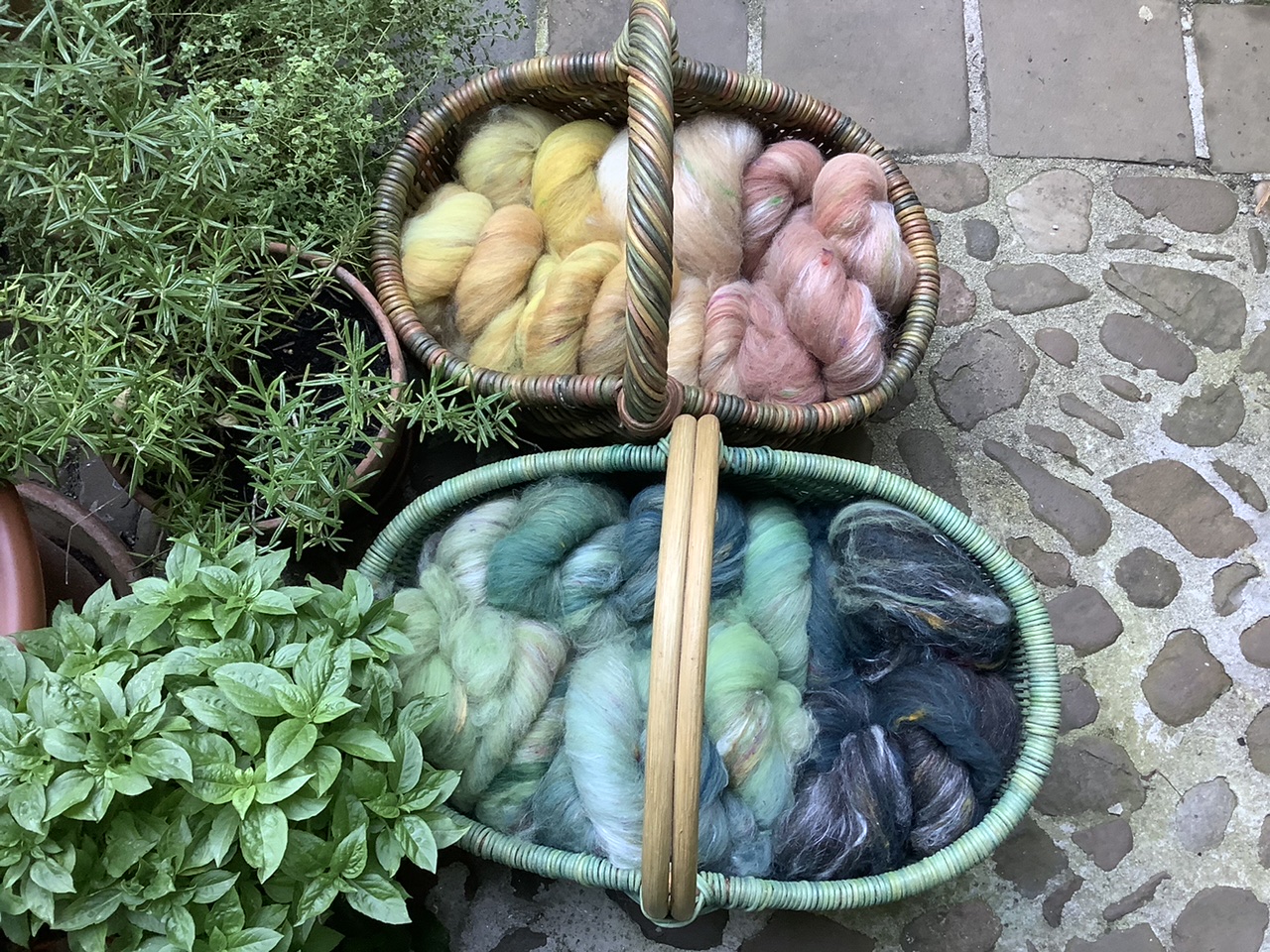
A highly photogenic collection of naturally dyed fibres.
I like to finish knitting one big project like a sweater or cardigan before I start the next one, or at least until I can’t carry it in my bag easily anymore, so I have an excuse to begin the next one. Sometimes it is good to have a second project on the go – I call it mindless knitting, where I don’t have to look very much – which I can keep my hands busy during Zoom or other meetings, which helps me listen.
Mixing colours and fibres
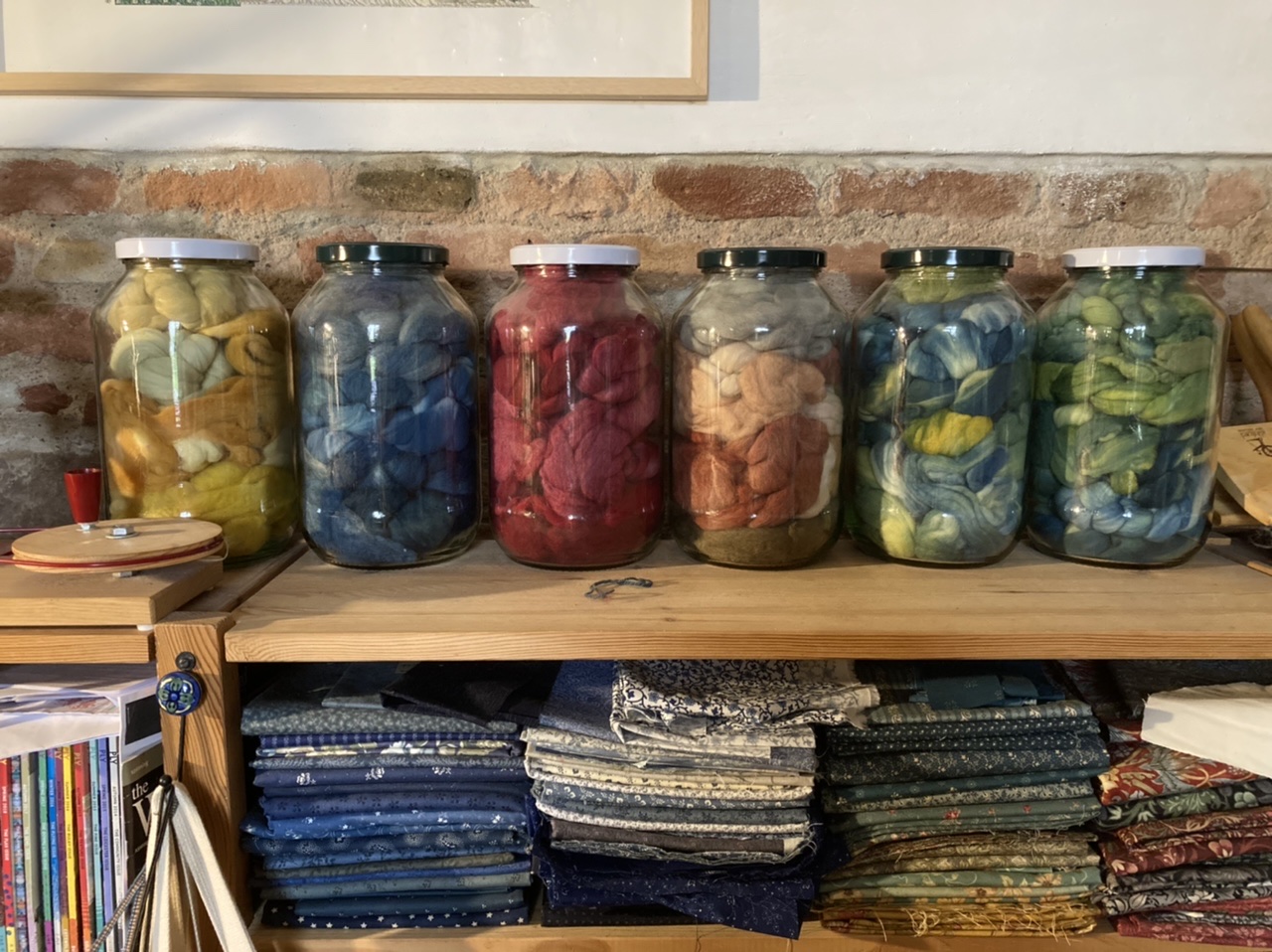
Usually I dye my yarn with plants which I collect in the woods or get from garden flowers. I also use cochineal and indigo, which I buy, to get lots of different colours. I really love the greens and blues I get from dyeing with indigo. I have lots of dyed wool, and all those colours give me inspiration for further projects.
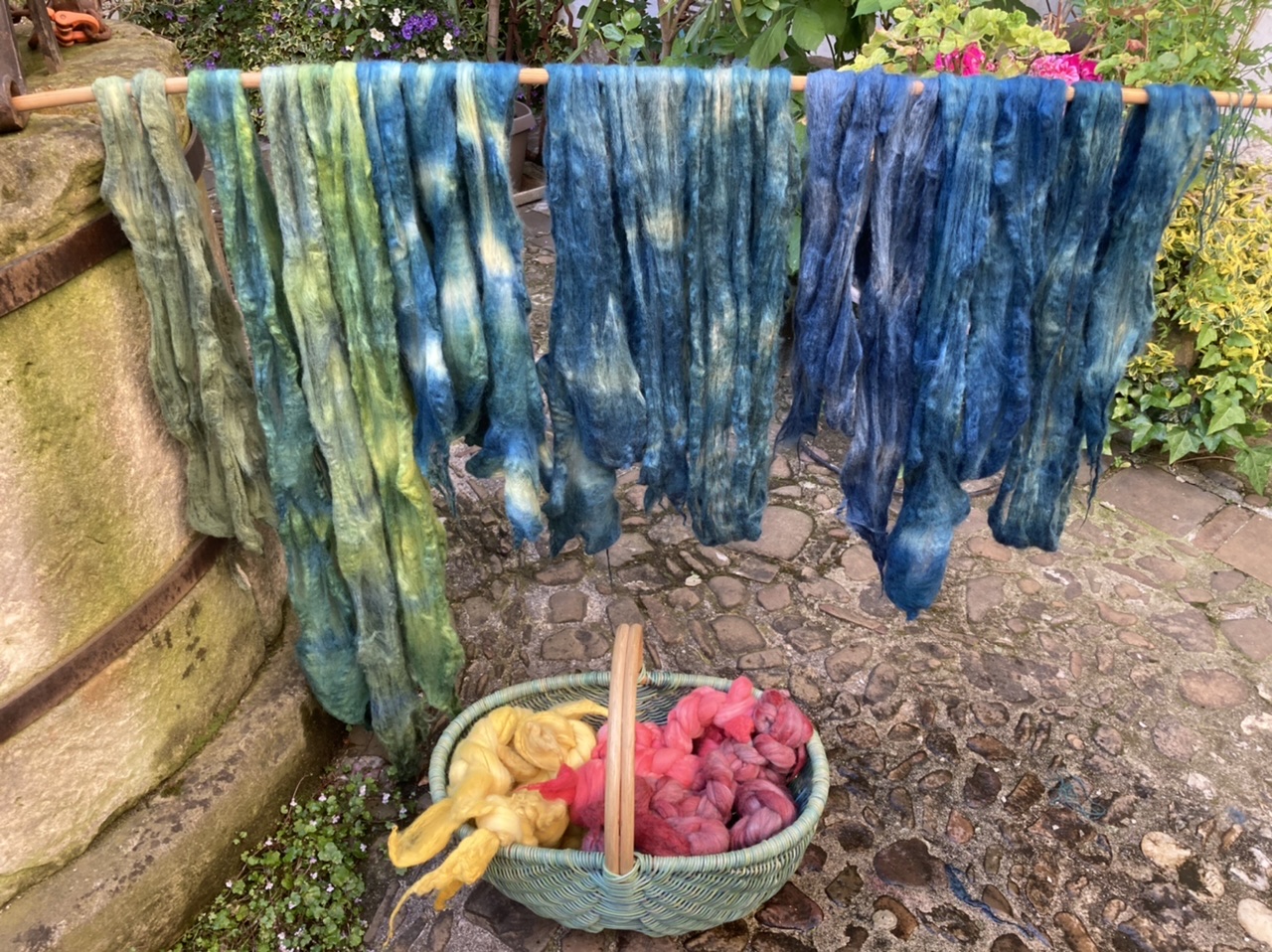
Beautiful greens and blues dyed by the author using indigo and other natural dyes.
Blending the wool on the drum carder I can get even more shades. I like to blend with fibres like silk, alpaca, or plant fibres, and I love sari silk, to get those little bits of colour in my yarn.
Fibres of different types and colours are blended on a drum carder for elegant results.
When I have an idea for the next sweater, I start carding, and then I can begin to spin. Once I have spun enough yarn – say, for one day – I cast on and start knitting, usually top down, so I don’t have to decide too much in advance about length and width.
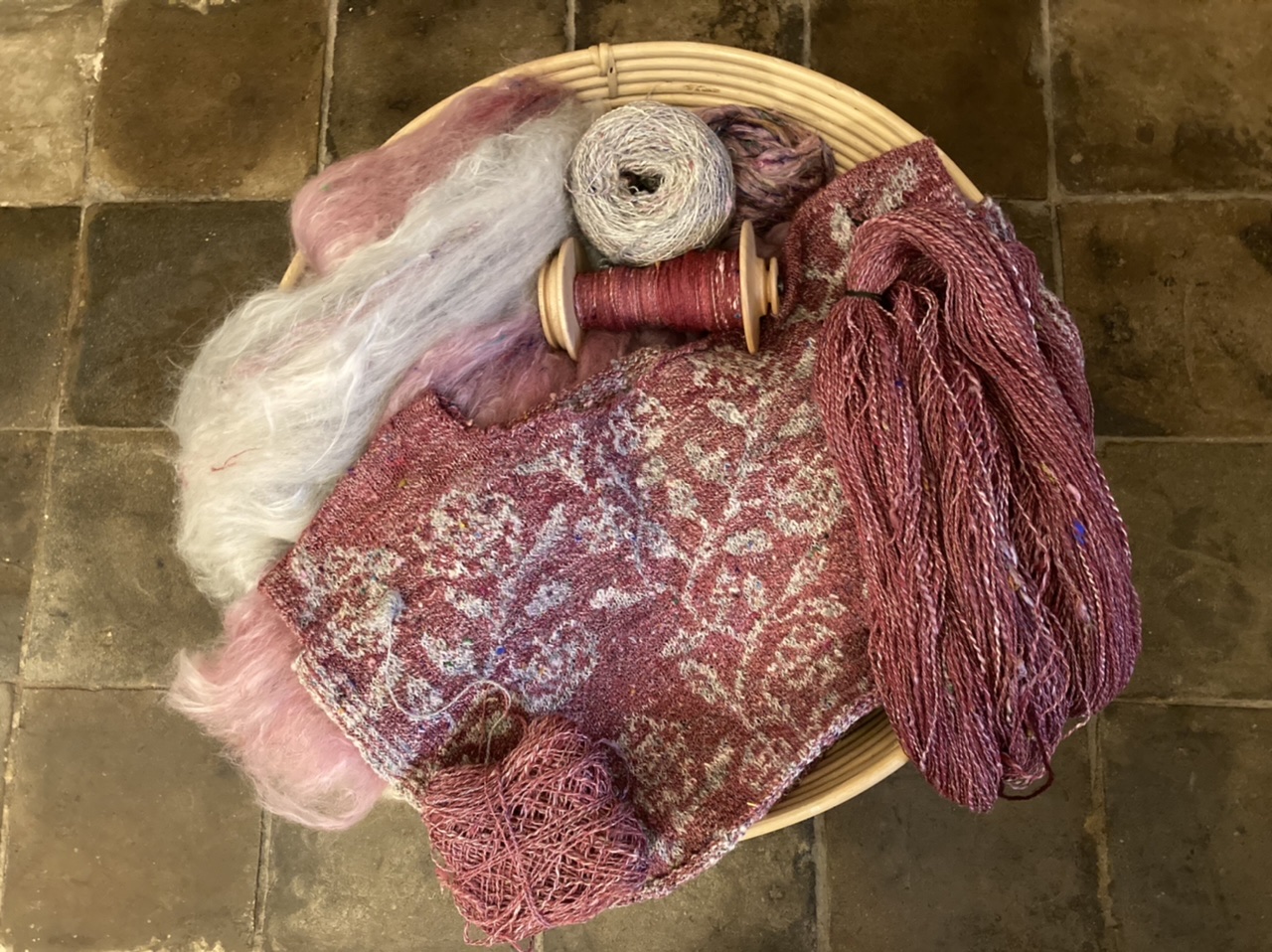
An idea for the author’s next sweater in the gathering stages.
When I spin on my wheel, I have to sit at home, but while spinning I can read a book or talk to others during online meetings. I also like to spin on my spindles, and that works on a walk, or a museum visit. I take them on holiday as they don’t need much space, and when I spin for a lace shawl, I don’t even need much wool either. At home there are spindles all over the place; I can spin when I am waiting for the kettle to boil, when the computer is slow, when I am cooking. Like that I can make good use of a short time and the yarn still grows.
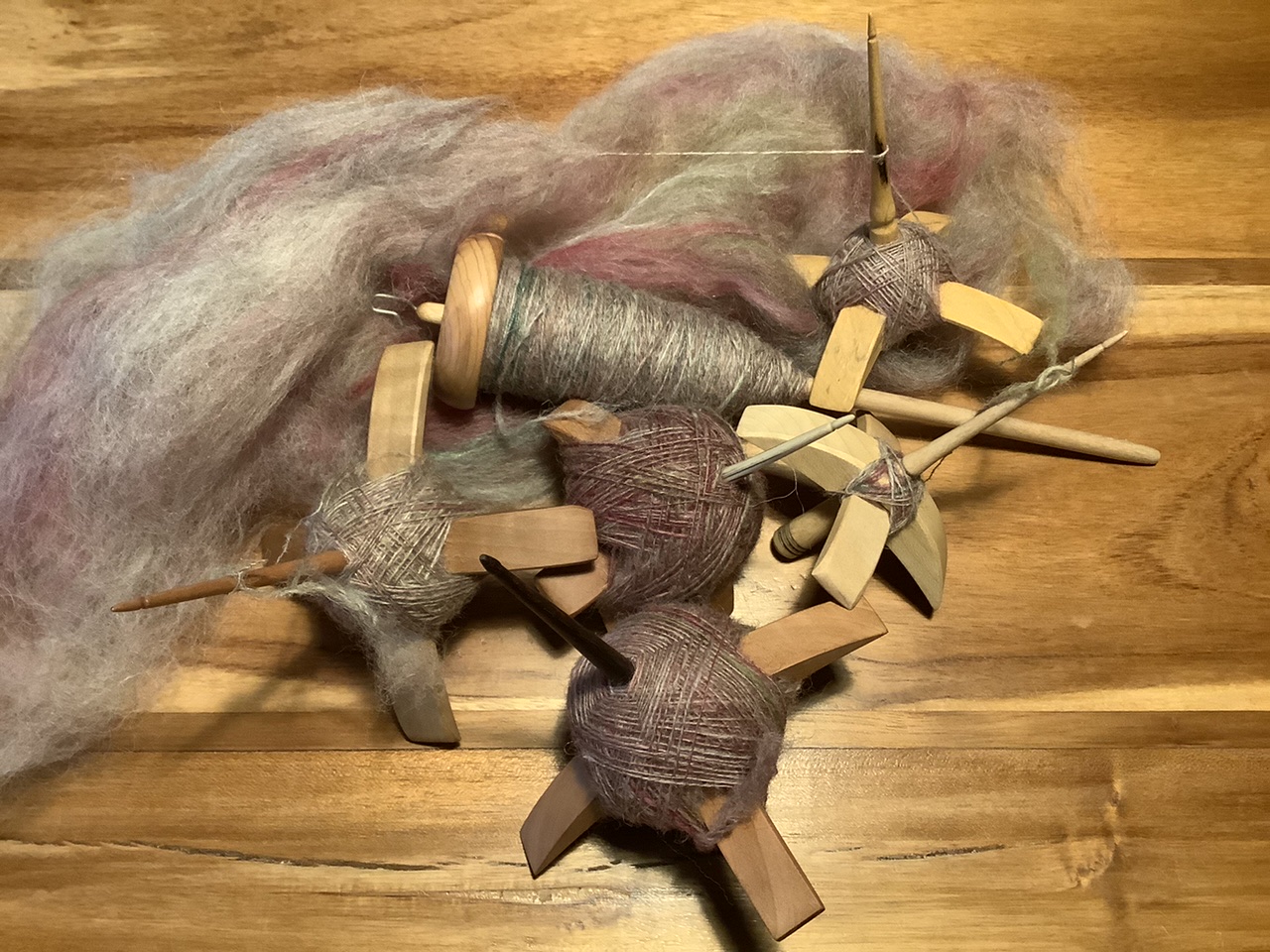
Knitting as soon as the yarn is spun helps the author complete sweater projects in a timely manner.
I can take my knitting almost everywhere, which is why I don’t want to wait to get started until I have spun all the yarn for a whole sweater. I knit at home, on the bus or train. The only thing I have to make sure of is to be one step ahead with the yarn.
I love to knit Fair Isle sweaters. My favourite method is to use only one bobbin, which I don’t even fill, because I need smaller quantities of lots of colours. Then I wind a ply ball and ply it on itself. For that I put my thumb through the ball, so I can tension the two singles with my fingers and they don’t get tangled, as long as my thumb (or a cardboard roll or a pencil) stays in the middle. I don’t have any leftovers from plying, and it is quick when I suddenly need more yarn.
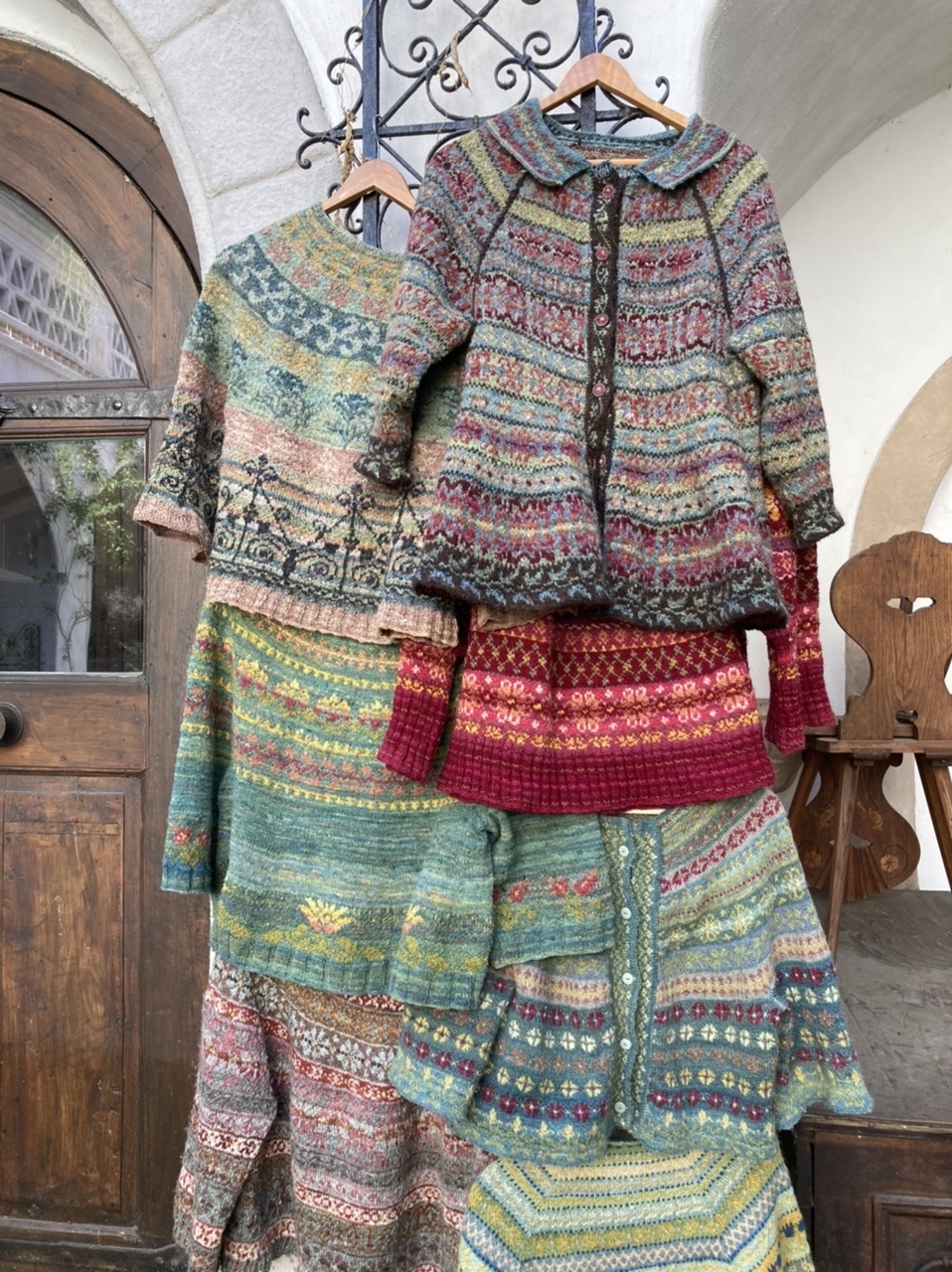
Several charming sweaters dyed, spun, and knit by the author.
I have never had problems with the yarn not being consistent enough throughout a project. I just know what yarn I want and my fingers seem to remember what to do. I am sure it is good advice to have a little card tied to the spinning wheel with a bit of the singles you are aiming for, so you can check and make sure you are spinning a consistent yarn.
Mixing breeds
There are so many different breeds, but some of my favourites are Shetland, BFL, and Jämtland – a Swedish breed. After dyeing them, I often forget what I have used, so when I do a new project it often turns out that I have used different breeds and fibres just to get the right colour. For the Fair Isle knitting I want to juggle lots of colours, which is more important to me than making a sweater out of only one breed.
Recently I made a pullover for my husband using about 12 different breeds and colours, even mixing short and long draw. For me it was a breed experiment and a way to use up lots of smaller quantities of wool I had in my stash. For that sweater I used combed top without blending.
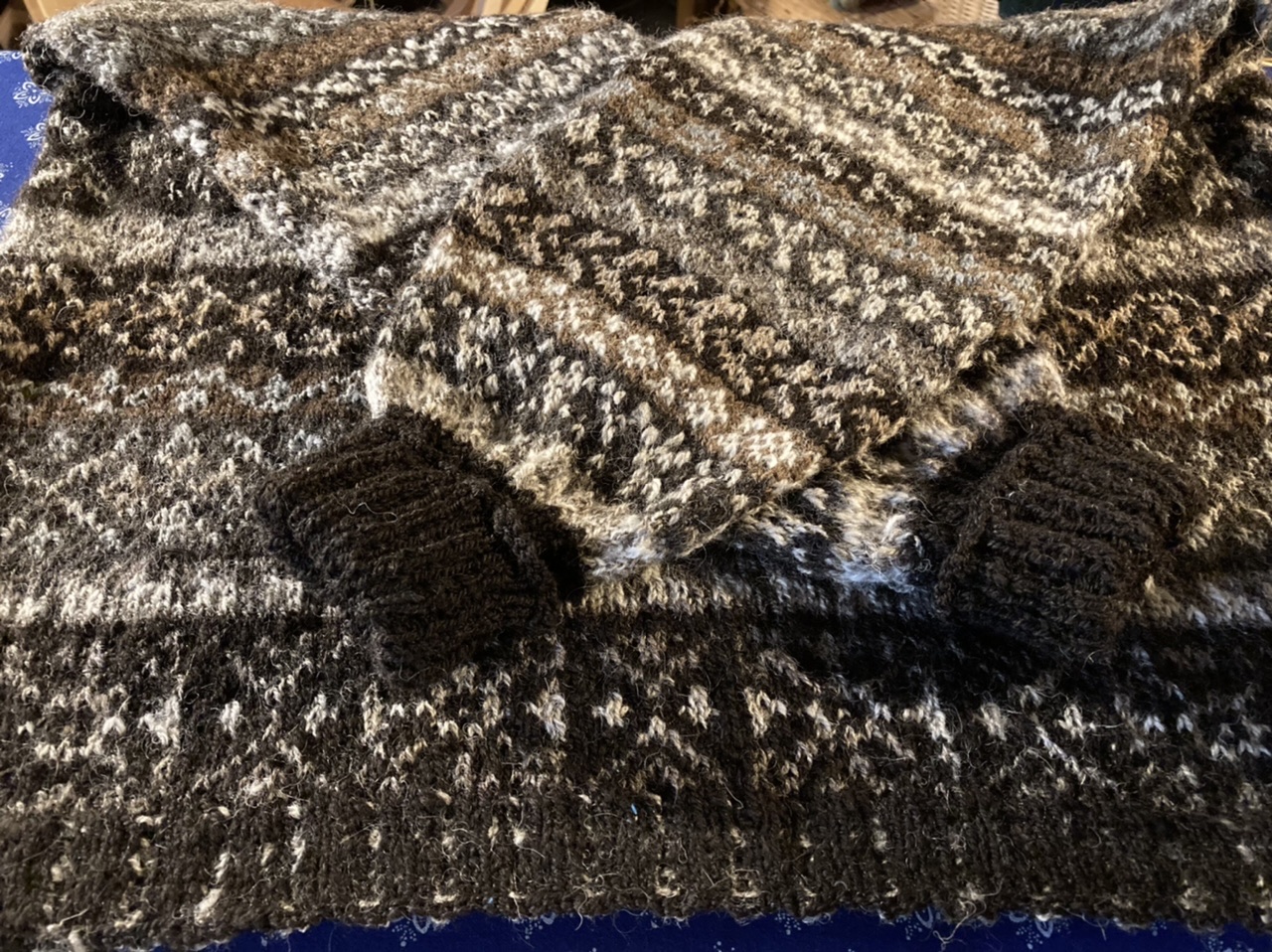
Mixing in knitting during the spinning process is a wonderful way for a spinner to avoid being overwhelmed during a sweater project.
My feeling is that some people don’t dare to start spinning for a bigger project because they get overwhelmed by the quantity they have to spin and then all the knitting there is to do, especially when you want to spin the yarn entirely on spindles. Mixing the spinning and knitting for the same project is more interesting; you get more variety and more freedom to choose what you want to do next as long as you don’t run out of yarn. It breaks the project down into smaller, less daunting parts. The only thing you might want to plan is to have enough fibre at the start, but even that is not necessary, there is always a sheep growing more wool.

Small Business Feature: The Foldout Cat
During this giving season, we’d like to call attention to some of our small business partners. You’ve seen The Foldout Cat featured in the PLY gift guide. Now we’d like for you to meet them as more than just the product they sell.

Q Wirtz, the owner and Chief Feline of the Foldout Cat, started her spinning journey in 2012, when she was still practicing law full-time. At that time, she primarily focused on crochet for her fiber fix. She purchased a Schacht Ladybug but quickly exiled it to the closet when Toxic Perfectionism(™) got the better of her. Within a few years, she’d essentially given up on spinning. In 2014, she left the full-time practice of law and moved to Alabama to be with her partners.
Q explained, “I was both burned out and worn out, and I had absolutely no clear idea of what I wanted to do – or could do – next.”
To keep herself busy, Q began selling her crochet with one of her partners at a weekly maker fair at one of Huntsville’s reclaimed textile factories, Lowe Mill. She adds, “I found myself increasingly recharged and inspired by the constant exposure to assertive creativity, and in relatively short order I applied for and was granted a studio space with the collective… In early 2017 I took the terrifying step of giving my creative endeavors a business name – naming is a powerful act! – and the Foldout Cat came formally into being.”
In 2018, something extraordinary happened. “That November, I went to a spinning retreat hosted by friends, attending for the company but dutifully toting my Ladybug and a bit of theoretically easy-to-spin roving along for the look of the thing. I sat down next to someone who’d taught spinning for the Haus of Yarn in Nashville, stuck my fluff into the leader loop she tied on for me, sighed deeply and put my feet on the treadles … and something just clicked. I went through the roving I’d brought with me in the first hour after that silent revelation and spent the rest of the weekend spinning anything and everything the other attendees were willing to throw my way. They were delightfully generous, as fiber folk often are.”
The Foldout Cat had a new direction: spinning and enabling.
“Given the amount of time I spend teaching spinning/talking about spinning/actually spinning these days, I surprise myself sometimes when I remember that I only started spinning six years ago!” Q adds, “I love teaching anyone who wants to sit down and fiber with me – but my favorite is working with folks at the beginning of their experience with a given fiber-art form. I like giving people permission to play, and to experiment – and above all, as they’re learning a new skill (or acquiring a new tool for an existing creative toolbox), to give themselves the grace in that learning that they would give a beloved friend.”

The Foldout Cat’s Goals
Goal #1: to support myself, financially and psychoemotionally.
Goal #2: to spread love and respect for fiber arts of all kinds.
Goal #3: to empower everyone I meet through my business – students, customers, fiber-adjacent spice and partners – to believe that they have a creative, artistic aspect, that it deserves to be recognized and honored, and that doing so will enrich their lives.
Goal #4: to keep putting beauty into this world–especially now, especially in these tumultuous days – and to help others to do the same.
If you are looking for a last-minute fiber gift for the discerning spinner in your life, consider working with Q to create a custom CatBatt! If you have ever seen The Foldout Cat at one of the many festivals and fiber retreats where they vend, you’ve probably had the pleasure of seeing her one-of-a-kind batt buffet where customers get to choose their fibers from a plethora of options and Q will blend a custom batt right then and there.
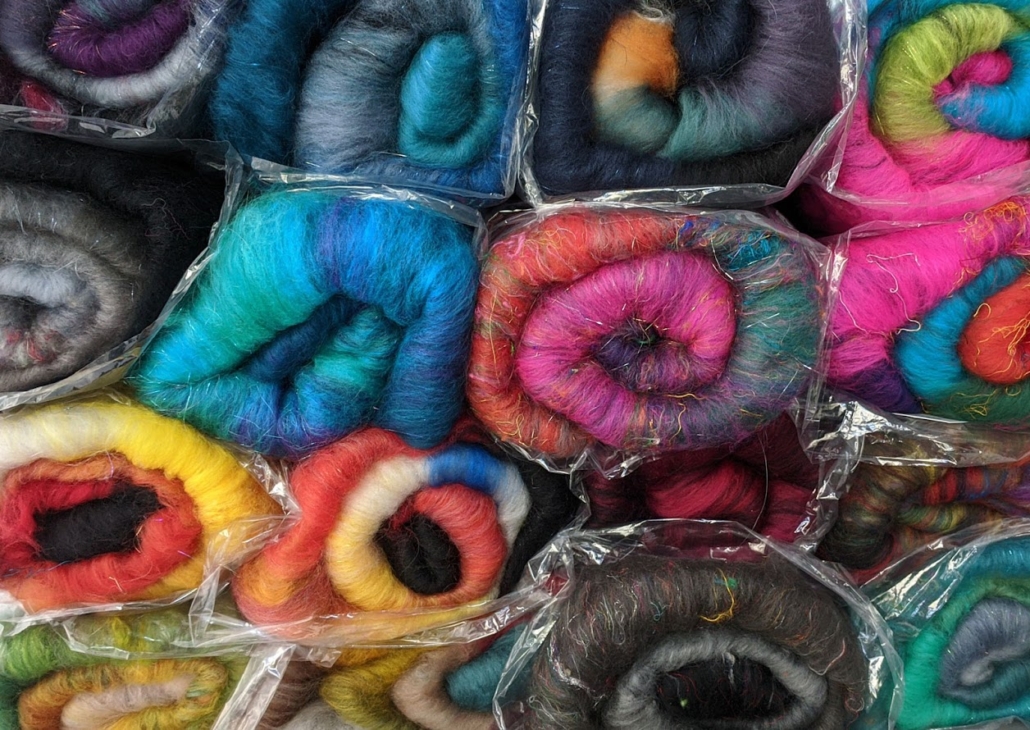
She extends this service to her website. “Right now, online customers have two options there: they can send me an email and I’ll work with them remotely to build what they need or they can buy a gift certificate and use it in person at any of the 15+ shows to which I travel each year.” Design a batt for a loved one (or for yourself! You deserve some holiday fluff, too!) or give a gift certificate that allows your friends and family to design their own CatBatt.
Even if you don’t have the opportunity to grab a CatBatt now, you’ll have plenty of opportunities in the upcoming year. Q explains, “In 2024 I had the honor of being part of 18 events, from conferences like Convergence to huge festivals like Rhinebeck to intimate workshop series like the one I got to do at a good friend’s beautiful home studio in Georgia, and including the first-ever Alabama Fiber Festival in early November. My 2025 schedule’s on track to be even more packed – and I couldn’t be more grateful for all of the teaching and vending opportunities that presents.” Check out her website for a list of events where you can find the batt buffet in person this upcoming year!
Innovation at Bam Fiber Works
When we think about fiber tools, we think about tens of thousands of years of progress and the history of innovation. We imagine the slow roll of progress bringing us to today, where we’ve obviously got everything figured out, right? This is as good as it gets! After all, we’re working in the slow arts, and we don’t need more than a stick to make some yarn. Some of us take joy in being able to prove that all we need is a stick!
Well, sometimes we like to make it a little easier on ourselves. Sometimes it isn’t about proving we can so much as getting the work done. The truth is innovation is happening every day in our fiber world. We have a strong community of toolmakers who are constantly looking to improve the tools we use. One of those toolmakers is Baruch with Bam Fiber Works.
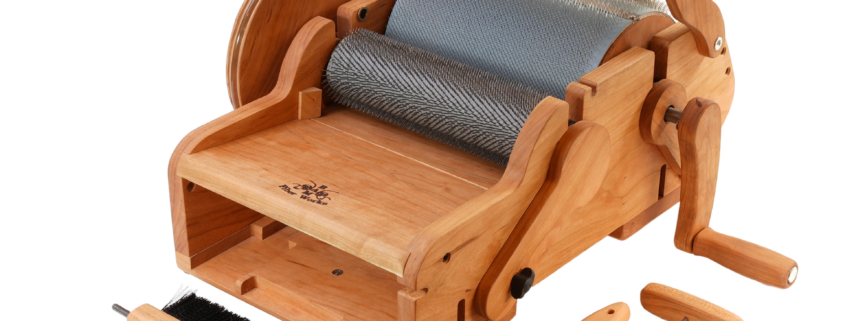
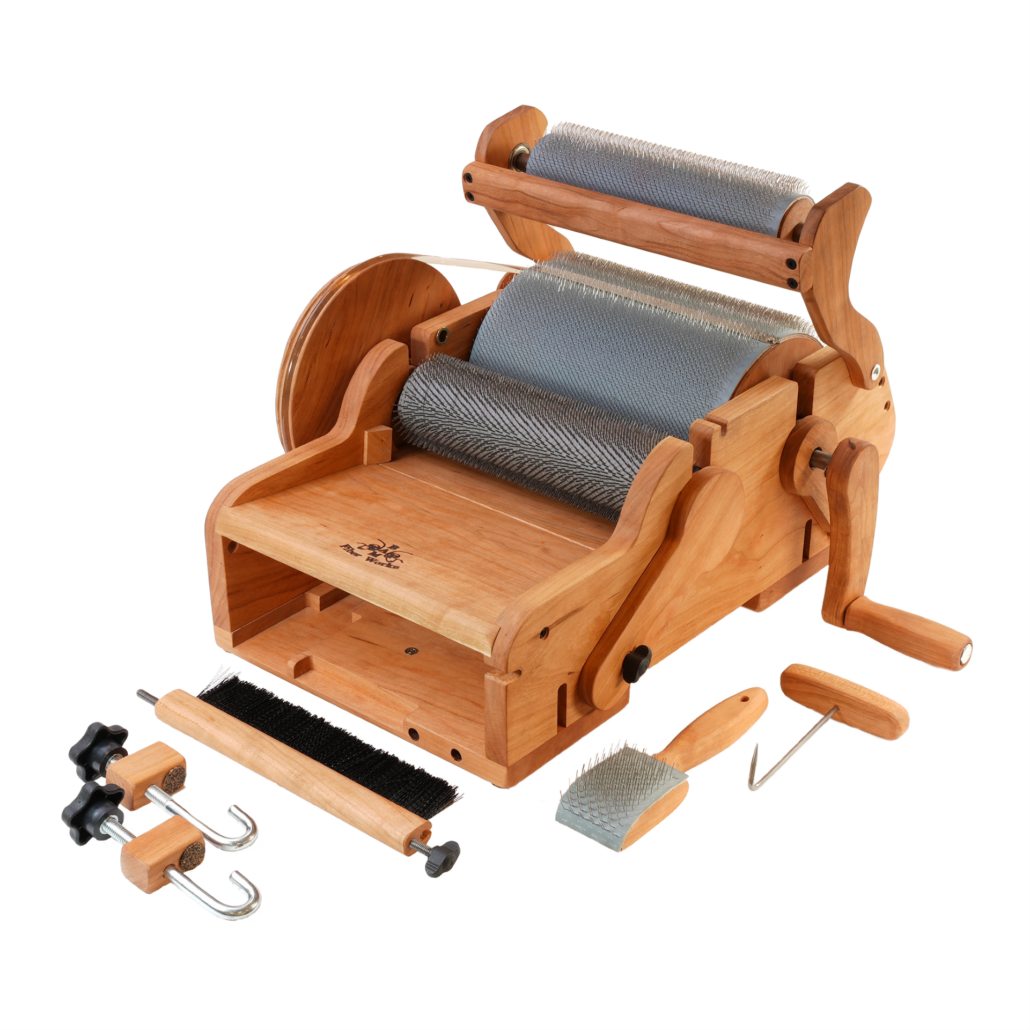
Bam Fiber Works has designed an incredible new feature for a workshop staple and is now offering a self-cleaning drum carder. You read that right! SELF-CLEANING. This patent-pending device is already on backorder through January 2025 as of the writing of this article.
The project to develop an improved drum carder started in 2016. “We wanted to create a drum carder that offered cool features that weren’t already offered in another drum carder on the market. We couldn’t quite put a finger on it, though,” Baruch told me. “The feedback we got again and again was to make the carder easier to clean.”
I personally felt that feedback in my soul. It had recently taken over an hour to deconstruct and deep clean the drum carder in my own workshop; work that needed to be done but that I took no pleasure from. I could have spent that time spinning… or at least catching up on some good television.
Baruch began by testing the concept of some sort of doffing cloth that could be used to remove fiber from the drum. Following many prototypes, he still wasn’t happy with how it performed. Then the magic happened. After a brainstorming session with his brother, Baruch discovered that a drum mounted on two pieces of scrap wood did a superior job. And he didn’t stop there. He wanted to make sure that his tool wouldn’t cause additional wear and tear on the carder itself. “We did over 1000 test cleanings. We filmed as we did it,” he said.
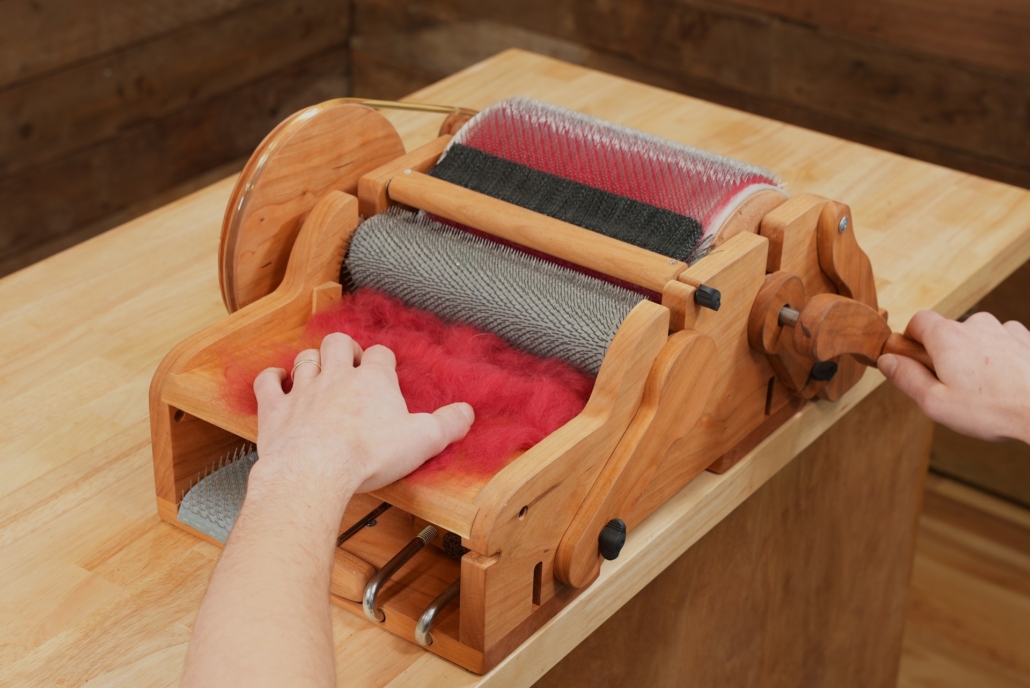
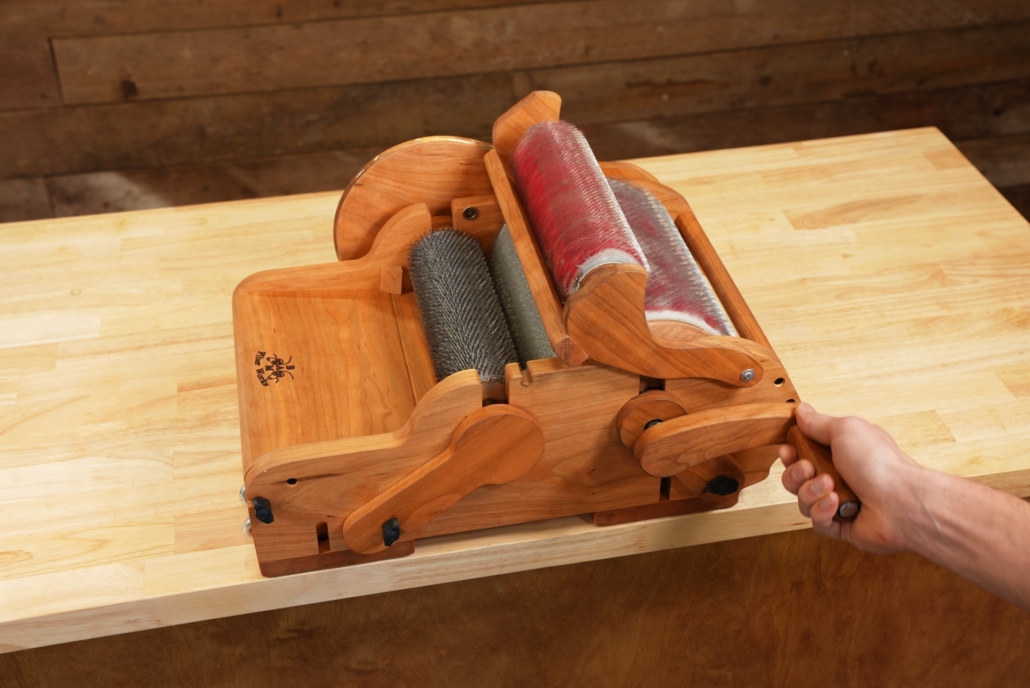
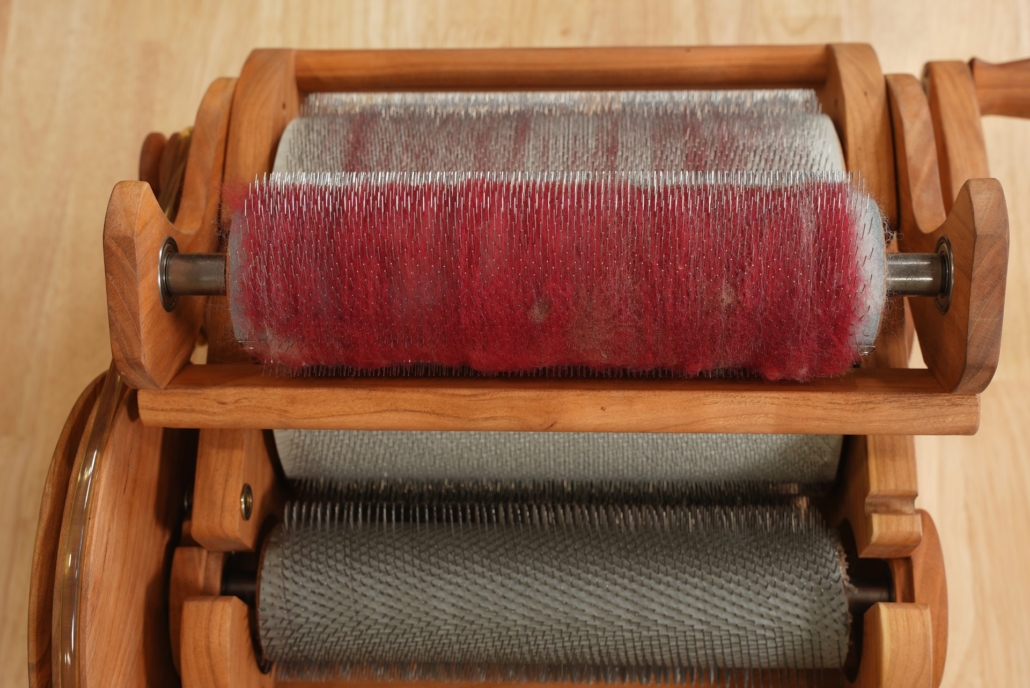
On top of the self-cleaning drum, the Bam Fiber Works drum carder features a number of unique features. Everything – clamps, doffing hook, cleaning brush – all store conveniently in the front tray of the drum carder. It has a magnetic pin lock system that allows pulleys, drums, and handle to be quickly removed, making it “crazy easy to clean.” And parts are designed to be used interchangeable amongst their entire product line.
“We wanted to take the unenjoyable parts out of carding,” Baruch added. “Take away the ‘I dread this’ part so that carding becomes more enjoyable on its own.”
That’s not all. While it is not yet available, Baruch and his team have a patent pending on a handheld version of the drum cleaner that could work with any drum carder. “There’s still a lot of testing to do,” he said. “Other brands have a variety of types of carding cloth in different weights. We want to make sure it works well and doesn’t damage people’s existing equipment.”
We in the fiber community have that to look forward to! In the meantime, readers can get on the pre-order list for this self-cleaning drum carder through the Bam Fiber Works website.
Planning Your Crafting Year
The beginning of the year is the perfect time for planning your crafting year – all the things you want to accomplish in your creative life before the next calendar year arrives. The first thing I want you to consider is your Why.
Why do you want to plan your crafting year? We all have different reasons. Perhaps you want to prepare handcrafted gifts for a family event or holiday. Maybe you’re ready to replace parts of your wardrobe with unique, handspun pieces. Or perhaps you want to improve certain skills to become a more proficient spinner. Understanding your Why will help you plan and adjust your year. Plan your year so your crafting reflects your Why and maintain flexibility for any life changes.
Spinning is a unique hobby because the end product, yarn, is just the raw material for another textile craft. As a multicraftual maker, I include using beautiful handspun yarn in my crafting year. As a spinner who enjoys working from raw fleece, my crafting includes picking and scouring fleece, fiber preparation, and sometimes dyeing.
Make a wish list
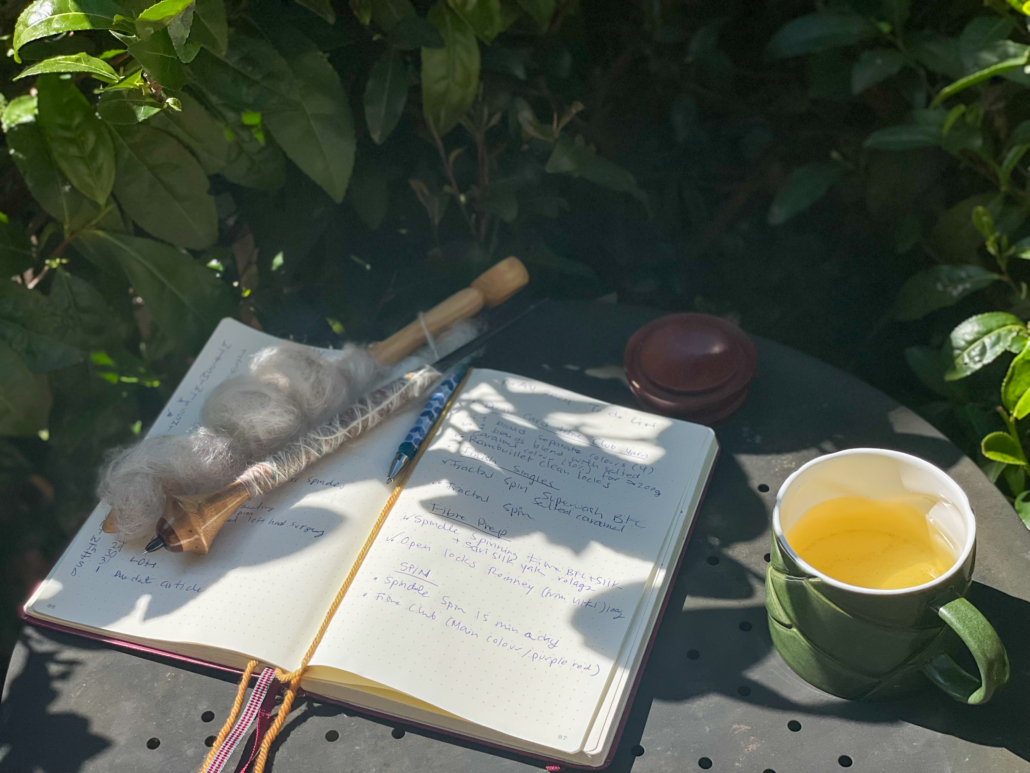
I use two tools for planning my projects: a wish list and make nine. Grab a notebook, pencil, and your favorite beverage. If you already follow a bullet journal practice, as described by Katherine Mead in the “Journaling to Grow” article, reserve a place in your journal for your crafting/creative wish list. This allows you to add items as they come to you and review them when planning your year.
Some examples of a wish list:
- Create a winter wardrobe for me
- Create a summer wardrobe for a significant other
- Spin a collection of 2-ply handspun yarns in the same weight (sport, DK, worsted) for use in various projects
- Create warp and weft yarn for two stoles
- Spin the box of summer dyeing fiber
- Spin full commercial hand-dyed braids (fractal, gradient, rill, raindrop, and marled)
- Spin complementary colors for a colorwork sweater to be knit with commercial yarn
- Spin two braids of fiber for an accessory
- Become proficient with the dizzing-off-the-hand-carder technique using five different commercial braids or wool breeds
- Prep fiber and spin the pound/half a kilo of scoured fleece from last summer
- Spin with my spindles at least 15 minutes every day
- Practice fiber preparation with the Lock Pop and drum carder
- Scour one or two pails of raw fleece from the last fleece auction
- Spin through the Fiber Club braids received every three months
Adding items to your wish list doesn’t mean you’ll tackle them all this year. This is just the first step.
Choose a theme
Along with your Why, choose a theme for your crafting year, such as His Wardrobe, My Summer Wardrobe, or Intentional Learning from Stash – whatever resonates with you.
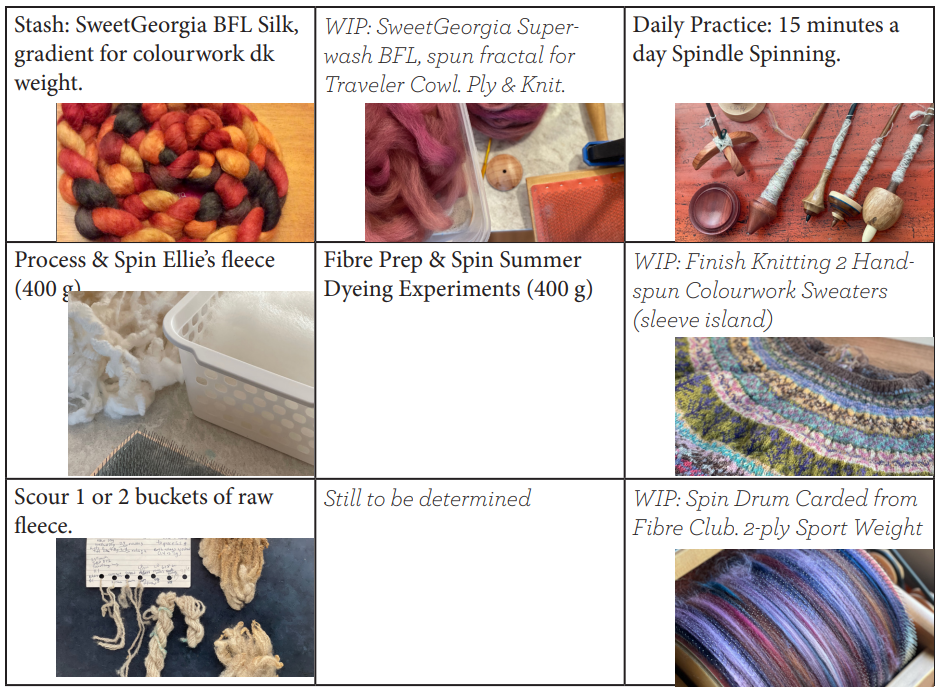
Draw a grid with nine spaces and title it with your chosen theme. Fill your make nine grid using your Why and wish list to guide your decisions. Here’s an example of my planning for the next 12 months:
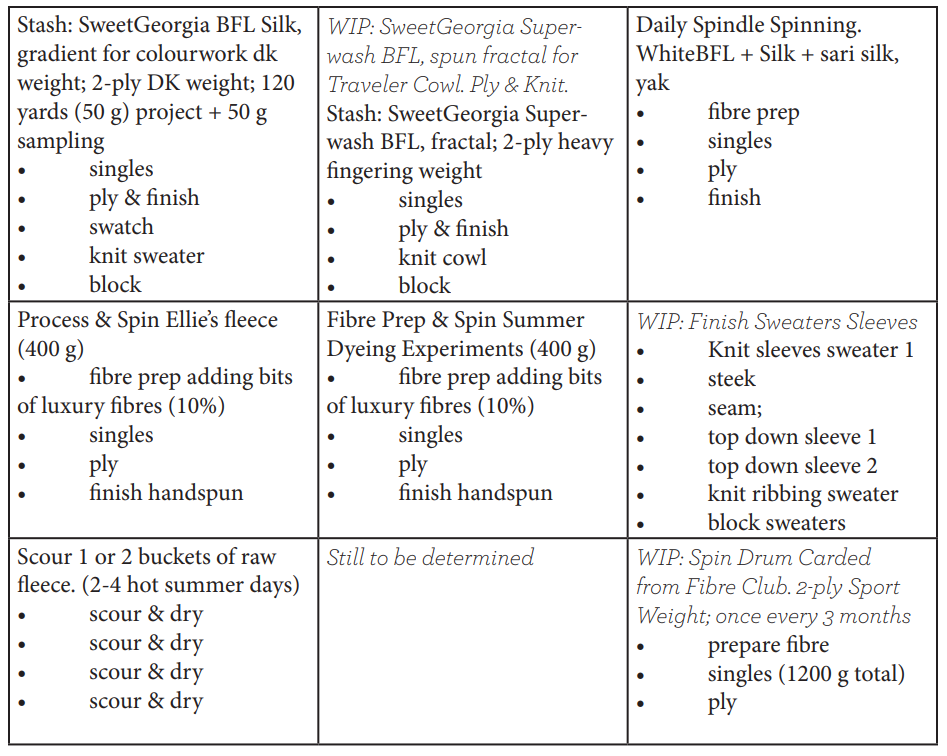
I want to spin beautiful yarns compatible with colorwork projects, improve my proficiency with fiber tools like the drum carder and the Lock Pop, and keep practicing my fiber prep skills with hand cards and blending boards. My make nine projects align with these interests and the crafting I enjoy. Note that I’ve included three works-in-progress. As spinners know, our craft is slow, and projects often carry over from the previous year. I also left one square open for any inspiring project or make-along I encounter during the year.
Find your tasks
Filling the make nine grid with attractive projects is satisfying, but it won’t become a reality if you keep it tucked away. New projects will fill your time if you let them.
List all the tasks needed to make your crafting list a reality. Identify the roadblocks for each project. For example, scouring fleece or fiber dyeing may be seasonal tasks best done in warmer months. Account for fiber prep time before spinning the singles or sampling time if that’s a roadblock for you. Add each task to a checklist you can mark off as you complete them.
Once I have my grid and checklist, I print the page and add it to my bullet journal. You might choose to stick it in your crafting area. Place it somewhere visible where you can check off tasks as you tackle them.
Craft your year!
For critical roadblock tasks, I schedule them on my calendar as I would a work meeting, ensuring I reserve time for them. I also add monthly tasks to my journal to stay on track with project progress. I enjoy photographing the process and sharing moments on social media. Reviewing these photos later inspires me and helps me remember successful processes.
Two or three months before the end of the year, I reassess my crafting progress and celebrate my successes. I also reflect on any projects left unfinished and consider whether I was too ambitious, failed to account for roadblocks, or got distracted by new patterns or spin-alongs. I include this reflection in planning the upcoming year to better align with how I like to spend my crafting time.
Planning my crafting year helps me be intentional with my projects, crafting garments that complement my daily life and ensuring I incorporate learning into my making. I hope what I’ve shared helps you start planning your crafting year too!
Greta lives in the Greater Vancouver area, Canada. She enjoys sampling and planning her crafting time. She loves being the Education Program Coordinator for the School of SweetGeorgia, where she is lucky to make a career of her passion. She shares life with her husband, five kids and a house full of wool, good food, coffee and tea. She may be found at the SOS forums, knitting, spinning, or walking with her family.
Words and photos by Greta Cornejo



Leave a Reply
Want to join the discussion?Feel free to contribute!